Connect with us

Events

23 Indigent Students Benefit from ₦14.9m Rotary District 9112 Scholarship Scheme

Published

on

Rotary

Rotary District 9112 awards ₦14.9 million scholarships to 23 students in Lagos and Ogun States under its educational welfare programme

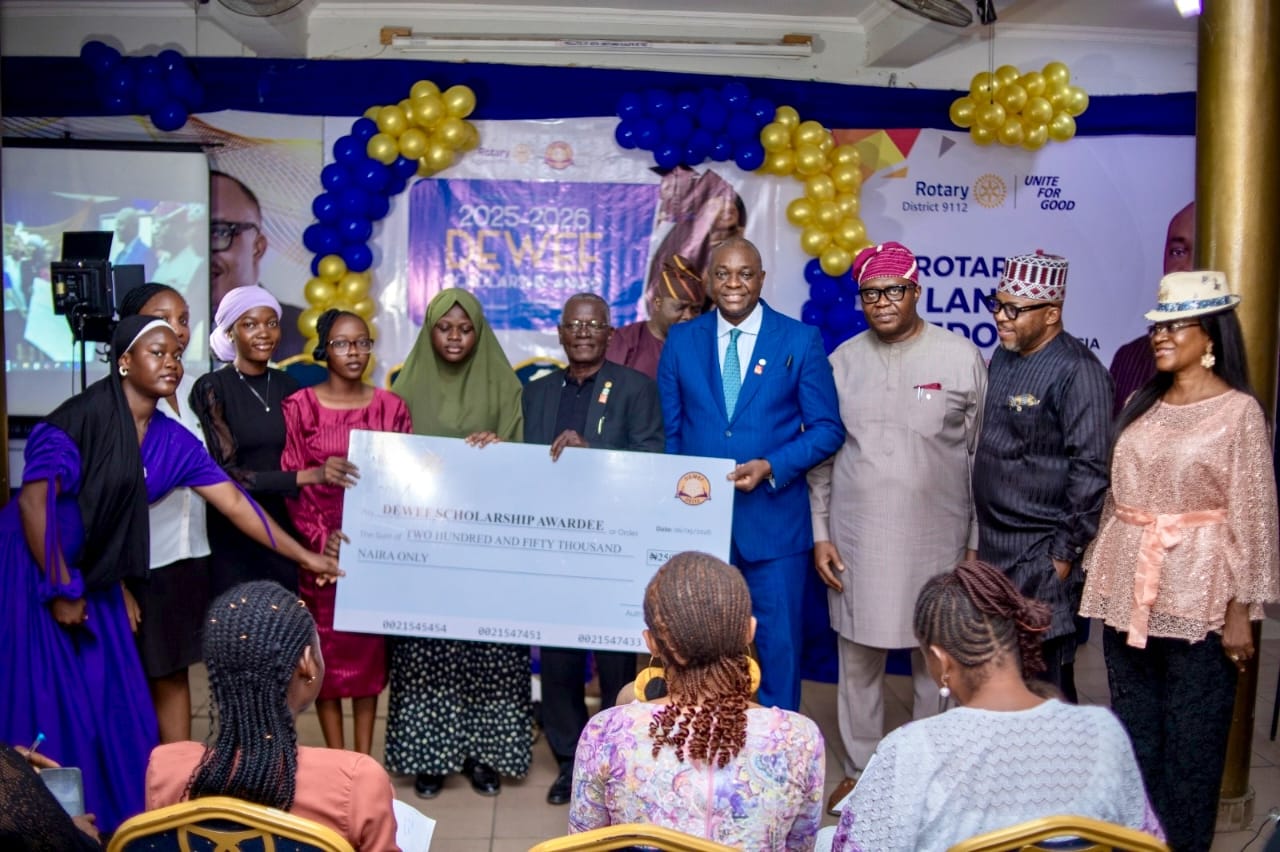
Rotary District 9112 has awarded ₦14.9 million in scholarships to 23 academically promising but financially disadvantaged students from Lagos and Ogun States under its flagship District Educational and Welfare Endowment Fund (DEWEF) programme.

Also read: NLNG launches 2026 Literature Prize adjudication process with 223 entries

Other previous beneficiaries, who are yet to complete their studies, were also presented rewards to further their education. These awardees were given the same ₦250,000 support, and the scholarships remain valid until they graduate.

The awards were presented at a colourful ceremony held on Wednesday, 6 May 2026, where beneficiaries, Rotary leaders, and family members gathered to celebrate the initiative’s continued impact on educational access.

The DEWEF Scholarship, which commenced in the 2006/2007 academic session, has become one of the district’s longest-running educational interventions, providing critical financial support to indigent students across its catchment area.

At the event, the Chairman of the DEWEF Scholarship Committee, PP Abosede Ewumi, delivered her address through a representative. The Chairman of the Board of Trustees, PDG Yomi Adewunmi, also addressed the gathering, underscoring the programme’s significance.

Beneficiaries were selected through a rigorous process that included application reviews and verbal interviews to determine both academic merit and genuine financial need.

District Governor Lanre Adedoyin described the awardees as “my young friends” and charged them to remain focused on their studies while taking full advantage of personal development opportunities. He particularly encouraged them to join Rotaract clubs in their institutions, describing the platform as vital for developing leadership skills and a spirit of community service.

Each beneficiary received ₦250,000, reflecting a significant increase in both the number of recipients and the value of the award compared to previous years.

In separate interviews, the students expressed gratitude for the timely intervention.

David Oyewole Oyewunmi said he learned about the scholarship through a friend and found the application process largely straightforward, despite initial difficulty securing a recommendation letter from his school.

“The registration process was seamless even though getting the recommendation letter from the school was not. All in all, it was seamless,” he said.

Usman Mololuwa Alimat noted that the scholarship would ease her financial burden and allow greater concentration on her academics. “The funds will help me financially and also help me focus on my studies more,” she said.

Temitope Oladimeji, who heard about the opportunity through her campus fellowship, explained that the support would relieve pressure on her parents. “The token would ease the burden on me and my parents. I thank the organisers of the DEWEF initiative and every Rotarian that donated,” she said.

A previous beneficiary, Sofiat Muhammed (2024/2025), shared how the scholarship had transformed her academic journey.

“The bursary has helped ease my hurdles and made my studies smarter and easier,” she said, describing the programme as truly life-changing.

The heartfelt testimonials underscored the growing human impact of the DEWEF Scholarship, which continues to open doors for deserving young Nigerians.

Also read: JOINT STATEMENT BY NGE & SERAP ON WORLD PRESS FREEDOM DAY

Rotary District 9112 reaffirmed its commitment to expanding educational opportunities and empowering the next generation through sustained humanitarian service.

Continue Reading
Click to comment

Leave a Reply

Culture

Crowds Gather for Rare Sunrise at Egypt’s Abu Simbel Temple

Published

on

Abu Simbel

Hundreds of tourists gathered at Egypt’s Abu Simbel temple to witness the twice-yearly sunrise ceremony illuminating Pharaoh Ramses II’s statue

Hundreds of tourists gathered at Egypt’s Abu Simbel temple on Thursday to witness a spectacular sunrise phenomenon in which sunlight illuminated the face of the statue of Pharaoh Ramses II, an event that occurs only twice a year.

Also read: 16 Famous Cultural Festivals That Define India

The ancient astronomical ceremony drew visitors from different parts of the world to the archaeological site in southern Egypt on October 22, one of two dates associated with the phenomenon.

The second occurrence takes place on February 22, when the rising sun illuminates the temple’s interior.

Egyptian tour guide Yasser Fouad described the occasion as extraordinary, saying some visitors had stayed overnight to secure the opportunity to witness the event.

“Today is an extraordinary day, everyone is keen, there are people who stayed over the night, foreigners who actually spent the night in Abu Simbel to see this phenomenon,” Fouad said.

The Great Temple of Ramses II at Abu Simbel dates back to the 13th century BC and is among Egypt’s most prominent archaeological attractions.

Built during the reign of Ramses II, one of ancient Egypt’s most powerful pharaohs, the temple is renowned for its monumental statues and sophisticated architectural design.

The twice-yearly sunrise phenomenon is a major attraction, drawing visitors eager to witness the interaction between sunlight and the temple’s ancient structure.

The dates have traditionally been associated with significant moments in Ramses II’s life.

October 22 is commonly linked to his birthday, while February 22 is associated with his accession to the throne.

However, the precise historical reasons behind the dates remain debated.

Some archaeologists have proposed alternative explanations, including that they may have marked the pharaoh’s coronation and birthday.

Abu Simbel underwent a major international rescue operation in the 1960s, when archaeologists and engineers relocated the temples to protect them from flooding caused by the construction of the Aswan High Dam.

The monumental structures were cut into large blocks and reassembled at a higher location, preserving the site for future generations.

The relocation was one of the most significant archaeological preservation projects of the 20th century.

Despite the move, the temple continues to attract visitors for its ancient Egyptian art, monumental architecture and remarkable alignment with the rising sun.

Also read: 16 Famous Cultural Festivals That Define India

The annual gatherings highlight the enduring appeal of Egypt’s archaeological heritage and the continuing fascination with the astronomical knowledge and engineering achievements of its ancient civilisation.

Continue Reading

Entertainment

Gbenga Adeyinka Brings Laffmattazz 2026 Finale to Lagos

Published

on

Laffmattazz

Laffmattazz 2026 Lagos finale will hold on November 15, as Gbenga Adeyinka brings comedy, music, culture and fashion to Victoria Island

(more…)

Continue Reading

Entertainment

The Headies Announces New Date for 18th Awards Edition

Published

on

Headies

The Headies has rescheduled its 18th awards edition to April 10 and 11, 2027, in Toronto, Canada, with industry events continuing

(more…)

Continue Reading

Trending