Connect with us

Culture

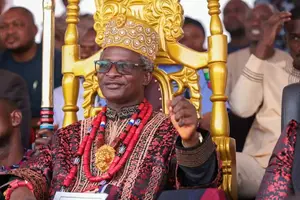
Idoma monarch outlaws expensive funerals, pegs bride price at N50,000

Published

on

The Idoma Area Traditional Council of Benue State, on Wednesday, declared that there shall be no more expensive burial ceremonies in the Idomaland and announced N50,000 as the unified traditional bride price to be paid by a man taking a wife from the tribe.

The paramount ruler of Idoma nation, the Ochidoma, His Royal Majesty Elaigwu John, unveiled the decisions in his New Year message released to the press on Wednesday by the Chief Palace Scribe, Onuminya Odoba.

According to the press release, the Idoma monarch was out to reform “some self-imposed, barbaric, and harsh cultural practices” that make life difficult for the people.

Idomaland, which has the second largest population in Benue State, has seven local government areas and the tribe can also be found in Nasarawa, Taraba and Cross River states.

Akonitv reports that the reforms are coming about one year and a half after the ascension of John, an ex-Deeper Life Pastor, as Ochidoma in June 2022.

The monarch said the reforms were undertaken by the Idoma Area Traditional Council after wide consultations with rulers, political leaders, and their subjects.

In the statement, the monarch declared; “Our deliberations arrived at the following conclusions for the immediate adherence of all true Idoma people, clans, tongues, and people under the Idoma Area Traditional Council:

“Imposition of costly prescriptions, stipulations, and requirements on the bereaved family for the burial rites of a deceased person is hereby prohibited in Idomaland.

“Burial rites should be conducted within affordable means of the family and, as much as possible, concluded within two to three weeks from the date of death.”

The council also prohibited “the practice of depriving the children and wife or wives of the deceased from inheriting his property.”

“The practice whereby relatives deny and deprive the children and wife or wive of the deceased of their right to inheritance of the deceased’s property is hereby prohibited.

“For the avoidance of doubt, where the deceased is survived by wife or wives and children, such children and wife or wives shall have the right of first consideration, in the apportioning of the inheritance, in the absence of a written will.”

On the burial of a married woman, the monarch said, “The deceased’s wife shall be buried in her husband’s place, except in special circumstances where the wife, during her lifetime, was married to and had children for more than one man, in which case, the wife may be buried in her father’s place to allow other husbands and children to partake in the burial rites.”

On marriage, the monarch said, “Traditional bride price in Idomaland is hereby unified and fixed at N50,000.

“All forms of stringent conditions, stipulations, and expectations associated with traditional marriage are hereby removed and prohibited.”

He also barred “indiscriminate burial of corpses within and around the community, especially in residential areas is prohibited, forthwith.”

“Every community is mandatorily required to, within a period not later than 31st December 2024, earmark and designate a place in each village or hamlet, as a burial ground, to bury corpses.

“Where for any special reasons, a person has to be buried within or around the compound, the permit of the traditional ruler must first be sought and obtained and such burial spot or grave must be marked and secured,” the monarch said.

Culture

Dexter Loko Wins Prestigious 2026 Chinua Achebe Prize

Published

on

 Dexter Loko Wins Chinua Achebe Prize for his 170,000-word fantasy novel, The Bako of Zereshé, at the 2026 ANA convention in Abuja

(more…)

Continue Reading

Culture

Ofala festival: Obi of Onitsha marks 25 Years on throne

Published

on

 Ofala Festival 2026 celebrated Onitsha’s royal heritage as Obi Nnaemeka Achebe marked 25 years on the throne and addressed Nigeria’s economic challenges.

(more…)

Continue Reading

Culture

Crowds Gather for Rare Sunrise at Egypt’s Abu Simbel Temple

Published

on

Abu Simbel

Hundreds of tourists gathered at Egypt’s Abu Simbel temple to witness the twice-yearly sunrise ceremony illuminating Pharaoh Ramses II’s statue

Hundreds of tourists gathered at Egypt’s Abu Simbel temple on Thursday to witness a spectacular sunrise phenomenon in which sunlight illuminated the face of the statue of Pharaoh Ramses II, an event that occurs only twice a year.

Also read: 16 Famous Cultural Festivals That Define India

The ancient astronomical ceremony drew visitors from different parts of the world to the archaeological site in southern Egypt on October 22, one of two dates associated with the phenomenon.

The second occurrence takes place on February 22, when the rising sun illuminates the temple’s interior.

Egyptian tour guide Yasser Fouad described the occasion as extraordinary, saying some visitors had stayed overnight to secure the opportunity to witness the event.

“Today is an extraordinary day, everyone is keen, there are people who stayed over the night, foreigners who actually spent the night in Abu Simbel to see this phenomenon,” Fouad said.

The Great Temple of Ramses II at Abu Simbel dates back to the 13th century BC and is among Egypt’s most prominent archaeological attractions.

Built during the reign of Ramses II, one of ancient Egypt’s most powerful pharaohs, the temple is renowned for its monumental statues and sophisticated architectural design.

The twice-yearly sunrise phenomenon is a major attraction, drawing visitors eager to witness the interaction between sunlight and the temple’s ancient structure.

The dates have traditionally been associated with significant moments in Ramses II’s life.

October 22 is commonly linked to his birthday, while February 22 is associated with his accession to the throne.

However, the precise historical reasons behind the dates remain debated.

Some archaeologists have proposed alternative explanations, including that they may have marked the pharaoh’s coronation and birthday.

Abu Simbel underwent a major international rescue operation in the 1960s, when archaeologists and engineers relocated the temples to protect them from flooding caused by the construction of the Aswan High Dam.

The monumental structures were cut into large blocks and reassembled at a higher location, preserving the site for future generations.

The relocation was one of the most significant archaeological preservation projects of the 20th century.

Despite the move, the temple continues to attract visitors for its ancient Egyptian art, monumental architecture and remarkable alignment with the rising sun.

Also read: 16 Famous Cultural Festivals That Define India

The annual gatherings highlight the enduring appeal of Egypt’s archaeological heritage and the continuing fascination with the astronomical knowledge and engineering achievements of its ancient civilisation.

Continue Reading

Trending