
History
How Yoruba Brimah Dynasty Was Established in Ghana After Attack On Ilorin

Published
4 years agoon
By
akonitv
Just a few months after the attacks on Ilorin, which led to the fall of the Oyo empire by the Fulani Jihadists and the converted muslim followers of Afonja in 1810, several Yorùbá warlords and noblemen fled to different part of Yorùbáland for safety and succor.
Some even left Yorùbáland totally to form new Yorùbá settlements. One of such people was Chief Ibrahim the first.
Chief Ibrahim was a Yorùbá warlord and a military leader at the Old Òyó empire.
Despite being a muslim, he fled Ilorin, not because of fear but because the Fulanis took over the political and spiritual administration of the town. He then went to present day Ghana via the northern border with a lot of other Yorùbá high chiefs.
This was more than two hundred years ago and he was welcomed by the High chief of the Ga people. He welcomed him with open arms due to his Ile Ife connection.
His name, Ibrahim was corrupted into Brimah which has now become the norm in Ghana when referring to his dynasty.
This Might Interest You Col. Abubakar Dangiwa Umar: Buhari’s Skewed Appointments Shall Bring Ruin and Destruction to Nigeria
His dynasty is a member of the traditional council of kings and chiefs in Ghana as the Oba of all Yoruba descendants who came with him 200 years ago and those who came later.
Chief Ibrahim, the patriarch of the Yorùbá Brimah dynasty in Ghana fled Ilorin approximately 200 years ago and migrated to present day Ghana to form a settlement called “Zango”. His dynasty is a member of the traditional council of kings and chiefs in Ghana as the Oba of all Yoruba descendants who came with him 200 years ago and those who came later.
He was a soldier, a warrior, a merchant, a devout Muslim but a radical loyalist to his Yorùbá race. He was one of the Yorùbá Ilorin muslims who fought against Alimi and Afonja during the Afonja rebellion against the Aláàfin.
How he and his descendants till date were able to remain radically loyal to their Yorùbá Òyó heritage despite being a high ranking Islamic scholar could be a mystery to many.
This Might Interest You What is the difference between a Deed of Assignment and a Deed of Sale?
Most especially the fact that he lived at the same time with Afonja and Alimi, the Fulani leader in the town of Ilorin.
There were actually several Yorùbá Ilorin high chiefs who were astute Muslims who fought against Fulani imperialism in Ilorin during the Afonja rebellion.
As a matter of fact, he escaped to present day Ghana to stay off the bounty of the Fulanis because of his allegiance despite being a muslim by birth.
Chief Ibrahim the first had performed the hajj pilgrimage in the late 18th century meaning he was alive during the Òyó empire as a nobility and as a warrior.
The Brimah dynasty is the traditional, political and spiritual leader of the Yoruba in Ghana till date. The dynasty is also recognized by both the British colonial government and the government of Ghana till date.
The present Òbà of the Brimah dynasty is Chief Peregrino Hamza Braimoh who is a first class king and high chief.
This Might Interest You Effects of Population Growth on the Environment
Till date, his descendants identifies themselves first as Yorùbá before being a Ghanaian.There are Yorùbá land across west Africa and outside the continent. I was surprised when I met a lady at Kotoka Airport, Accra, who had never lived in Nigeria before but spoke flawless Òyó Yorùbá.
She was born in Ghana, carries a Ghanaian passport, spoke two local languages fluently but spoke Yorùbá like someone who lives in Ilorin or Iseyin.
Like also in Benin Republic, someone with the name Babatunde Salawu in Yorùbáland would appear on the Benin passports as Tuonde Salaou because it would be written in French language.
As a meritorious, Yoruba race is well famous in the world. The only thing holding Yoruba land back might just be not having her own country.
Yorùbá own communities in other countries such as Cuba, Brasil, Togo, Benin Republic, Ghana, Jamaica, and Haiti.
Source: onews
Related


Culture
Netherlands Returns Historic Benin Artefact to Oba Ewuare II

Published
2 weeks agoon
October 22, 2026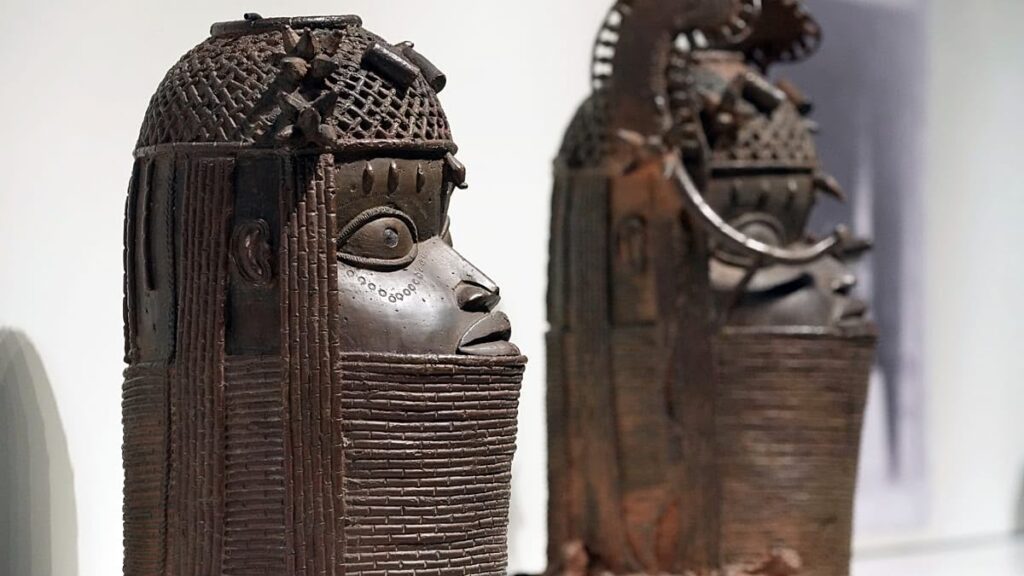
Netherlands returns Benin artefact to Oba Ewuare II as the restitution of African cultural treasures gains momentum during his 10th coronation anniversary
The Kingdom of the Netherlands has returned a centuries-old Benin artefact to the Oba of Benin, Oba Ewuare II, in Benin City, Edo State, as part of activities marking the monarch’s 10th coronation anniversary on October 21, 2026, in a move that adds momentum to international efforts to restore African cultural heritage to its place of origin.
Also read: Detty December Fest Adds DJ Tunez, Tungba Christmas
The artefact, which had been held in the collection of Museum de Fundatie in the Netherlands since 1937, was presented to the monarch by the museum’s executive director, Beatrice von Bormann, in the presence of Portugal’s Ambassador to Nigeria, Paulo Martins Santos.
The handover highlights renewed efforts by museums and governments to address the history of African cultural objects held in foreign collections and reconnect communities with artefacts of historical, cultural and spiritual significance.
Speaking during the presentation, von Bormann said investigations had traced the artefact’s origins to the 18th century.
She expressed satisfaction at its return to the Benin Kingdom, noting that the object had travelled across different parts of the world before reaching its place of origin.
She also explained that the artefact carried spiritual symbolism associated with reincarnation and Olokun, the Benin deity linked to the sea and wealth.
The return comes amid a broader international campaign to secure the restitution of African cultural treasures taken during colonial encounters.
The Benin Kingdom has been at the centre of these efforts, with historical objects from the former Benin Kingdom dispersed among museums and private collections across several countries.
Receiving the artefact, Oba Ewuare II reflected on the longstanding historical relationship between the Benin Kingdom and Portugal, recalling contacts between the two societies dating back to the 15th century.
The monarch said early encounters included efforts to introduce Catholicism into the kingdom but stressed that the Benin people had maintained their traditional religious beliefs and spiritual practices.
“We have a very unique link with the Portuguese. When I was told that the Portuguese Ambassador was around, it was like telepathy, because I had been thinking already about Portugal,” Oba Ewuare II said.
The monarch also expressed surprise at learning that the Vatican recognised African traditional religions, describing the development as significant to wider discussions about the recognition of indigenous African spirituality.
The presentation added historical and cultural significance to the celebrations marking Oba Ewuare II’s 10th coronation anniversary, while drawing attention to the role of restitution in preserving the identity and heritage of the Benin Kingdom.
The return of the artefact also reinforces calls for continued cooperation between African institutions and international museums to establish the origins of disputed objects and facilitate their return where appropriate.
Also read: Detty December Fest Adds DJ Tunez, Tungba Christmas
For the Benin Kingdom, the recovery represents more than the return of an old object. It offers an opportunity to preserve historical knowledge, sustain cultural traditions and pass an important part of the kingdom’s heritage to future generations.
Related


Olumo Rock, is not only significant to the historical legacy of the Egba people, it is also a tourism icon of inestimable proportion for Ogun state. Just like the name “Olumo” meaning “Planted by God Almighty,” this monumental tourist and historical site holds fascinating history that should never be forgotten.
You should never forget these 13 facts about Olumo Rock.
1. It is about 137 meters high and 1938 meters above sea level.
2. The name “Olumo” is a combination of two words; “Olu” (god/deity) and “mo” (moulded).
3. A famous hunter named “Adagba” discovered Olumo Rock.
4. It served as a hiding place during war, and for indigenes to clearly view the enemy’s advancement.
5. It was not just a shelter it also served as a tower of strength to the Egbas in protecting their territory.
6. Olumo Rock is very symbolic to the people of Egba because it represents nationalism, unity and freedom.
7. Egba warriors regarded Olumo Rock as a protection shrine and a place where sacrifices are made to its deity.
8. A woman called “Iya Orisa Olumo” lived her entire life under the famous rock. She was in charge of sacrifices made in the shrine to appeal to the gods of the rock.
9. The ruler of Egba, “Alake of Egbaland”, prays and offers sacrifices at the shrine on behalf of the people.
10. The rock houses a mystery tree which had been in existence for over 200 years. The tree is known to always flourish throughout the seasons.
11. Olumo Rock officially became a tourist site in 1976.
12. Olumo Rock is a natural edifice; pride of the people of Abeokuta and Nigeria at large.
13. Olumo Rock is located in Abeokuta, Ogun state.
Related

All encompassing, both in cultural dynamism, ethnicities, value, landscapes, natural resources and captivating scenic views all over the country, Nigeria is the true definition of a tourism attraction destination that gives you a run for your trip money!
Bauchi State – As the ‘Pear of Tourism’, Bauchi state is endowed with three wildlife parks and the most popular of them being the Yankari National Park, a large wildlife park which is home to a series of wildlife in their natural habitat. The glory of the scenic wildlife park radiates through its natural warm water springs, and varieties of flora and fauna. The tourism attraction is located about 110km along Bauch-Gombe road in the south-central part of the state covering 2,244 square kilometers. This location is in the heartland of the West Africa Savanna hereby making it the most popular destination for tourists who visit Nigeria. If you’re yet to take the trip, now is the time!
Akwa Ibom State – The “Land of Promise” glows with its captivating ‘Aqua Obio River’, although wrongly spelt and pronounced as the ‘Qua Iboe River’ by the early Europeans who came to Nigeria, regardless, this enchanting scenic view located in Ibeno Local Government Area of the state stands tall as one of Akwa Ibom State’s hydrographic features bringing all and sundry to experience the beauty of nature. The magnificent river rises near Umuahia in Abia State Nigeria and flows in the southeastern direction through Akwa Ibom state to the Atlantic Ocean.
Adamawa State – The ‘Land of Beauty’ as it is popularly called is characterised by all round inherent aesthetics. From the scenic mountain and land traversed by the massive river valleys of Benue, Gongola and Yadsarem with the valleys of Cameroon, Mandara and Adamawa Mountains, as well as tropical dry and rainy season climate, Adamawa State is indeed the land of beauty, one that everyone should have the pleasure of beholding in this lifetime.
Edo State – The ‘Heartbeat of the Nation’ gets its global attraction from a number of natural attractions within the state, however, The Okomu National Park also known as the ‘Okomu Wildlife Sanctuary’ located in the Ovia South-West Local Government Area of Edo State is one of the most beautiful natural rainforest ecosystem in the world. Take a trip to Edo State and see how Okomu National Park conserves the biodiversity of the region.
Bayelsa State – The ‘Glory of All Lands’ ‘Lake Efi’, a huge natural lake located between the Taylor Creek and Kalama compound in Sabagreia at Kolokuma/Opokuma Local Government Area of Bayelsa State makes both local and international tourists book Bayelsa State as a first destination especially during the fishing festival. The lake is seated on about 2 km square area and surrounded by a forest.
Related

Why Nigeria needs the All-Nigeria Rotary Peace Summit

Pasuma, Malaika Headline Star-Studded Owode Ifa Festival

Dexter Loko Wins Prestigious 2026 Chinua Achebe Prize


Trending

 Culture4 years ago
The Four Igbo Market Days and Their Significance In Omenala ÌGBÒ
- Business4 years ago
Ooni of Ife Discusses Business and Peace Initiative in Kenya
- Events4 years ago
Glamour, glitz as B’obagunwa Omo’ba Obinrin Akile Ijebu celebrates New Year party (Photos)
- Culture4 years ago
Outrage as Ezendigbo of Ibadanland confers chieftaincy title on Olubadan
- Events4 years ago
Onitoomu of Ito-Omu installs two new chiefs (Video, Photos)
- Events2 years ago
Egbe Bobasete: The New Fashion Sensation Elevates 2024 Ojude Oba Festival (Video, Photos)
 Events3 years ago
NANTAP Convention 2023: Reshaping Nigerian Theatre Arts for economic growth
- Paranormal4 years ago
Black Cat Superstition: Good and Bad Luck Beliefs


