Connect with us

Culture

Enugu Speaker pledges continued support for Igbo language, culture

Published

on

Enugu Speaker Igbo language

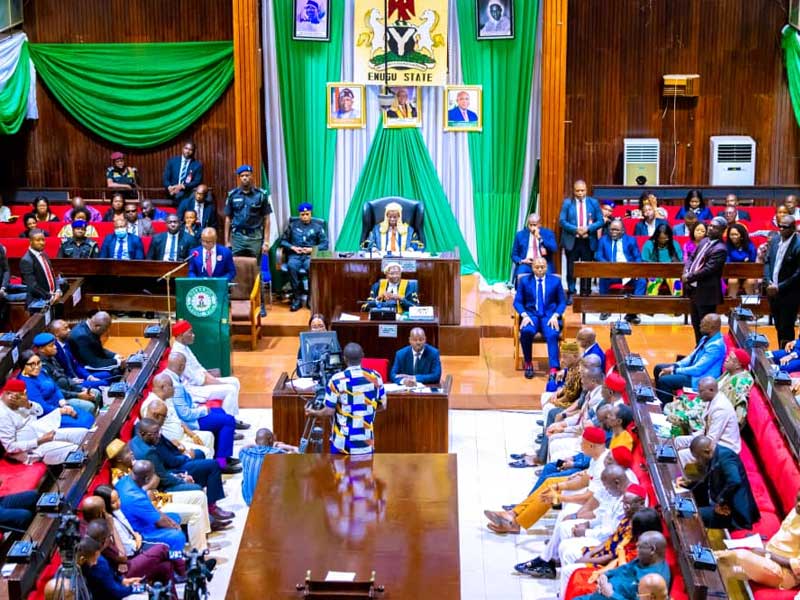
Speaker Uchenna Ugwu pledges continued support for promoting Igbo language and culture, emphasizing the importance of teaching future generations


The Speaker of the Enugu State House of Assembly, Hon. Uchenna Ugwu, has reiterated his commitment to supporting and promoting the Igbo language and culture, ensuring its sustainability for future generations.

Also read: Phynofest returns to Enugu: Phyno announces grand comeback of iconic concert

He made the pledge during an event commemorating International Mother Language Day 2025 in Enugu, organised by Igbo Efula, an indigenous NGO focused on the promotion of Igbo language and culture.

In his address, Ugwu stressed the collective responsibility of every Igbo person to pass down the language and cultural heritage to the next generation. “We all have a duty to teach our children the Igbo language, culture, and our rich heritage as Ndigbo,” he said.

He also expressed his delight in seeing secondary school students actively participating in activities related to the promotion of Igbo culture.

Ugwu assured attendees that the Enugu State House of Assembly would continue to support initiatives aimed at preserving the Igbo language, ensuring that it does not go extinct.

Ugwu commended Igbo Efula for its national recognition and continuous efforts to advance Igbo language, culture, and heritage. His sentiments were echoed by Dame Ugochi Madueke, the Enugu State Commissioner for Culture and Tourism, who praised Igbo Efula for its long-standing commitment to the cause.

She emphasised that while everyone has a role in promoting the Igbo language, parents have a particularly important responsibility in teaching their children to speak Igbo at home.

The event also saw contributions from Igwe Ikechukwu Asadu (Ogadagidi), Chairman of the Enugu State Traditional Rulers Council, who pledged the support of traditional rulers in advancing the Igbo language and culture. He also extended his support to organisations like Igbo Efula that are working towards the same goal.

Prince Chukwuemeka Onyesoh (Oba Agbalanze), the Chairman of the event, urged Igbo Efula to explore partnerships with other organisations dedicated to promoting the Igbo language.

He expressed his admiration for Igbo Efula’s work and encouraged all participants to take active roles in supporting the language in their homes and communities.

Former Chairman of the South East Council of Traditional Rulers, Igwe Lawrence Agubuzu, who is also the Chairman of the Board of Trustees of Igbo Efula, called for continued support for the organisation’s efforts to revive and promote the Igbo language.

Agubuzu expressed his gratitude to the dignitaries who attended the event, acknowledging their role in fostering the growth of the Igbo language and culture.

In his opening address, Mazi Ikechukwu Oji, President of Igbo Efula, stressed the need for a stronger emphasis on making the younger generation realise the importance of speaking Igbo fluently without any sense of compulsion.

He also called for greater support from various levels of government and stakeholders in the Igbo film and music industry, which he identified as key to promoting the language on a global scale.

The event served as a reminder of the critical need for collective efforts to preserve the Igbo language and culture, ensuring it thrives for generations to come.

Through collaboration between government, traditional leaders, and organisations like Igbo Efula, the promotion of Igbo language remains a top priority in Enugu State.

Culture

Dexter Loko Wins Prestigious 2026 Chinua Achebe Prize

Published

on

 Dexter Loko Wins Chinua Achebe Prize for his 170,000-word fantasy novel, The Bako of Zereshé, at the 2026 ANA convention in Abuja

(more…)

Continue Reading

Culture

Ofala festival: Obi of Onitsha marks 25 Years on throne

Published

on

 Ofala Festival 2026 celebrated Onitsha’s royal heritage as Obi Nnaemeka Achebe marked 25 years on the throne and addressed Nigeria’s economic challenges.

(more…)

Continue Reading

Culture

Crowds Gather for Rare Sunrise at Egypt’s Abu Simbel Temple

Published

on

Abu Simbel

Hundreds of tourists gathered at Egypt’s Abu Simbel temple to witness the twice-yearly sunrise ceremony illuminating Pharaoh Ramses II’s statue

Hundreds of tourists gathered at Egypt’s Abu Simbel temple on Thursday to witness a spectacular sunrise phenomenon in which sunlight illuminated the face of the statue of Pharaoh Ramses II, an event that occurs only twice a year.

Also read: 16 Famous Cultural Festivals That Define India

The ancient astronomical ceremony drew visitors from different parts of the world to the archaeological site in southern Egypt on October 22, one of two dates associated with the phenomenon.

The second occurrence takes place on February 22, when the rising sun illuminates the temple’s interior.

Egyptian tour guide Yasser Fouad described the occasion as extraordinary, saying some visitors had stayed overnight to secure the opportunity to witness the event.

“Today is an extraordinary day, everyone is keen, there are people who stayed over the night, foreigners who actually spent the night in Abu Simbel to see this phenomenon,” Fouad said.

The Great Temple of Ramses II at Abu Simbel dates back to the 13th century BC and is among Egypt’s most prominent archaeological attractions.

Built during the reign of Ramses II, one of ancient Egypt’s most powerful pharaohs, the temple is renowned for its monumental statues and sophisticated architectural design.

The twice-yearly sunrise phenomenon is a major attraction, drawing visitors eager to witness the interaction between sunlight and the temple’s ancient structure.

The dates have traditionally been associated with significant moments in Ramses II’s life.

October 22 is commonly linked to his birthday, while February 22 is associated with his accession to the throne.

However, the precise historical reasons behind the dates remain debated.

Some archaeologists have proposed alternative explanations, including that they may have marked the pharaoh’s coronation and birthday.

Abu Simbel underwent a major international rescue operation in the 1960s, when archaeologists and engineers relocated the temples to protect them from flooding caused by the construction of the Aswan High Dam.

The monumental structures were cut into large blocks and reassembled at a higher location, preserving the site for future generations.

The relocation was one of the most significant archaeological preservation projects of the 20th century.

Despite the move, the temple continues to attract visitors for its ancient Egyptian art, monumental architecture and remarkable alignment with the rising sun.

Also read: 16 Famous Cultural Festivals That Define India

The annual gatherings highlight the enduring appeal of Egypt’s archaeological heritage and the continuing fascination with the astronomical knowledge and engineering achievements of its ancient civilisation.

Continue Reading

Trending