Connect with us

Events

When Edo gained strong stakeholder support for heritage policy

Published

on

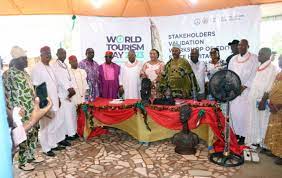
Diverse stakeholders from various sectors united at the Ogba Zoological Garden during the recent celebration of World Tourism Day (WTD) 2023, to participate in the stakeholder validation workshop for the Edo State Heritage Protection and Promotion Policy Draft.

This event was attended by an array of stakeholders, representing a broad spectrum of interests, including traditional rulers and chiefs, scholars, artisans, entertainers and government officials, underscoring the policy’s wide-reaching implications.

The participants engaged in meaningful discussions on the draft heritage policy, emphasising its importance and potential socioeconomic benefits in protecting heritage sites, monuments and traditions and helping them to become drivers of growth and employment.

Highlighting the need for holistic involvement, Edo State Commissioner for Tourism, Arts, and Culture, Dr Uyi Oduwa-Malaka, noted that the government has assembled a strong and diverse team, spanning various sectors of the economy, to develop a comprehensive policy.

She stated that the ministry is working in close collaboration with relevant stakeholders across the state to guarantee the long-term effectiveness of the policy.

The Permanent Secretary of the ministry, Iryn Omorogiuwa (Esq.), highlighted the historical significance of the policy, saying, “It is very important that we keep our history, our stories and not let people tell us otherwise.

For the first time in history, we are going to have a document that focuses on us, our cultural and traditional heritage, our tangible and intangible assets.”

The workshop shed light on the significance of preserving culture in Edo State. Using the Benin moats as a prime example of a heritage asset in dire need of intervention, Prince Patrick Oronsaye, an esteemed art historian, emphasised the critical necessity of the policy, stating;

‘‘The greatest damage we suffered here is the moat, 16,000km put together in a period of almost 500 years, 37 million metric tonnes of earth, was moved in the creation, 150,000 man hours resulted in the Benin city moat, it took us 30 years to destroy it. We are talking about protecting what is left, from palaces, to shrines, to grooves.”

Stakeholders at the workshop also expressed their conviction that the Heritage policy will play a pivotal role in safeguarding Edo cultural assets both tangible and intangible, from further deterioration.

Eno Louis, renowned Nigerian musician and the convener of the Benin Bronze Festival, advocated for a collaborative approach to sponsorship, stressing that the ministry should aim to create an enabling environment for businesses within the cultural and creative industries to thrive in the state.

Another participant, Aiko Obobaifo of the Institute of Benin Studies, echoed the global significance of the policy, stating that “every black man in the world is waiting for Edo, for Benin to lead the way. “Our heritage is something they cannot replicate.”

Other stakeholders, including Mrs Elizabeth Hannisdal from Visit Edo and Mr John O. Igbineweka from Igbesanmwan Guild Carvers, expressed their optimism for the comprehensive Heritage policy and its potential to enrich the lives of Edo people.

The Edo State Heritage Protection and Promotion Policy represents an ambitious endeavour to preserve, protect and celebrate Edo State’s cultural heritage.

The collaborative spirit of the workshop portends well for the policy’s successful implementation.

Continue Reading
Click to comment

Leave a Reply

Culture

Crowds Gather for Rare Sunrise at Egypt’s Abu Simbel Temple

Published

on

Abu Simbel

Hundreds of tourists gathered at Egypt’s Abu Simbel temple to witness the twice-yearly sunrise ceremony illuminating Pharaoh Ramses II’s statue

Hundreds of tourists gathered at Egypt’s Abu Simbel temple on Thursday to witness a spectacular sunrise phenomenon in which sunlight illuminated the face of the statue of Pharaoh Ramses II, an event that occurs only twice a year.

Also read: 16 Famous Cultural Festivals That Define India

The ancient astronomical ceremony drew visitors from different parts of the world to the archaeological site in southern Egypt on October 22, one of two dates associated with the phenomenon.

The second occurrence takes place on February 22, when the rising sun illuminates the temple’s interior.

Egyptian tour guide Yasser Fouad described the occasion as extraordinary, saying some visitors had stayed overnight to secure the opportunity to witness the event.

“Today is an extraordinary day, everyone is keen, there are people who stayed over the night, foreigners who actually spent the night in Abu Simbel to see this phenomenon,” Fouad said.

The Great Temple of Ramses II at Abu Simbel dates back to the 13th century BC and is among Egypt’s most prominent archaeological attractions.

Built during the reign of Ramses II, one of ancient Egypt’s most powerful pharaohs, the temple is renowned for its monumental statues and sophisticated architectural design.

The twice-yearly sunrise phenomenon is a major attraction, drawing visitors eager to witness the interaction between sunlight and the temple’s ancient structure.

The dates have traditionally been associated with significant moments in Ramses II’s life.

October 22 is commonly linked to his birthday, while February 22 is associated with his accession to the throne.

However, the precise historical reasons behind the dates remain debated.

Some archaeologists have proposed alternative explanations, including that they may have marked the pharaoh’s coronation and birthday.

Abu Simbel underwent a major international rescue operation in the 1960s, when archaeologists and engineers relocated the temples to protect them from flooding caused by the construction of the Aswan High Dam.

The monumental structures were cut into large blocks and reassembled at a higher location, preserving the site for future generations.

The relocation was one of the most significant archaeological preservation projects of the 20th century.

Despite the move, the temple continues to attract visitors for its ancient Egyptian art, monumental architecture and remarkable alignment with the rising sun.

Also read: 16 Famous Cultural Festivals That Define India

The annual gatherings highlight the enduring appeal of Egypt’s archaeological heritage and the continuing fascination with the astronomical knowledge and engineering achievements of its ancient civilisation.

Continue Reading

Entertainment

Gbenga Adeyinka Brings Laffmattazz 2026 Finale to Lagos

Published

on

Laffmattazz

Laffmattazz 2026 Lagos finale will hold on November 15, as Gbenga Adeyinka brings comedy, music, culture and fashion to Victoria Island

(more…)

Continue Reading

Entertainment

The Headies Announces New Date for 18th Awards Edition

Published

on

Headies

The Headies has rescheduled its 18th awards edition to April 10 and 11, 2027, in Toronto, Canada, with industry events continuing

(more…)

Continue Reading

Trending