Connect with us

Culture

Renewed hope culture project launched in Katsina

Published

on

Renewed Hope Cultural Project

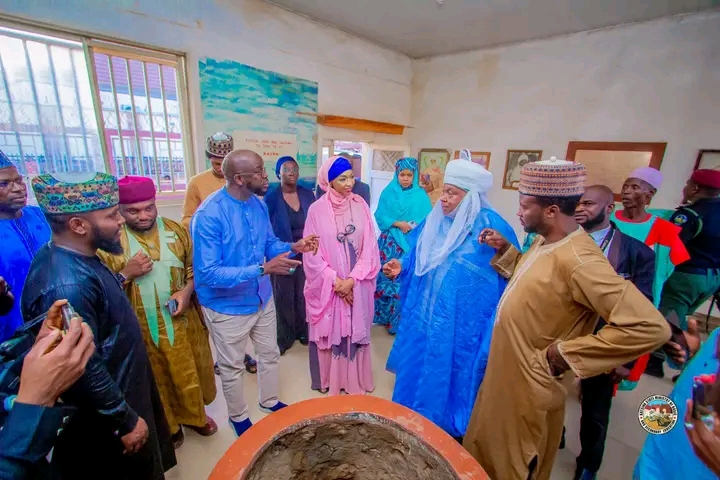
Minister Musawa launches the Renewed Hope Cultural Project in Katsina, a nationwide initiative to revitalise Nigerian culture and boost the creative economy across all states


Katsina State has marked the commencement of a significant national initiative as the Minister of Art, Culture, Tourism, and the Creative Economy, Barrister Hannatu Musa Musawa, officially launched the Renewed Hope Cultural Project.

Also read: Minister Hannatu Musawa reaffirms commitment to promoting Nigerian culture through art, fashion

This ambitious project aims to revitalise Nigeria’s rich cultural heritage and provide a substantial boost to the nation’s creative economy.

The Renewed Hope Cultural Project is slated for replication across all 36 states of Nigeria. Its core objective is to showcase the country’s diverse cultural tapestry and effectively harness local tourism potentials.

A central element of the initiative involves the establishment of Renewed Hope Cultural Villages. These villages will feature dedicated Creative and Art Studios, vibrant Arts and Crafts Markets, and engaging Exhibition Centres, each meticulously designed to reflect the unique cultural heritage of the host state.

Speaking at the flag-off ceremony, which took place at the historic Ƙofa Ukkur Gate in Katsina, Minister Musawa highlighted the crucial role of the project in preserving Nigeria’s history and driving significant economic growth.

“This initiative will drive local tourism, substantially boost the economy, increase GDP contributions, and create numerous job opportunities for millions of Nigerians nationwide,” she affirmed.

The Minister commended the Katsina State Government for its commendable efforts in preserving key historical landmarks, including the iconic Gobarau Minaret, the legendary Radar Daurama, the historic Kusugu Well, and the significant Durbi Takusheyi.

She further elaborated that the project would encompass the renovation of existing heritage sites and the implementation of capacity-building programmes for local artisans, with a particular focus on empowering young people within rural communities.

During her visit to the state, Minister Musawa also paid a courtesy visit to the Emir of Daura, Alhaji Umar Faruk, CON. She conveyed a goodwill message from President Bola Ahmed Tinubu, reiterating the President’s unwavering commitment to delivering grassroots-oriented development across the nation through people-centred initiatives.

In his response, the Emir of Daura expressed his profound appreciation to President Tinubu for the appointment of Minister Musawa, describing her as a “round peg in a round hole.” He lauded the cultural initiative and pledged the full support of the Daura Emirate for its successful implementation within the state.

Hon. Abiola Abdulkareem, the Minister’s Special Assistant on Subnational Development and Project Coordinator, emphasised the inclusive nature of the Renewed Hope Cultural Project.

He stated that the initiative would empower creatives at the grassroots level, ensuring that the government’s presence is tangibly felt through direct support for local craftsmanship and artistic endeavours.

Minister Musawa concluded her visit with an insightful tour of significant cultural sites, including the historic Fadar Daurama, the ancient Kusugu Well, and the Teachers Training College Museum, a site of historical importance.

She assured the state that the Federal Government would collaborate closely to ensure the preservation of these invaluable heritage landmarks for future generations.

Culture

Dexter Loko Wins Prestigious 2026 Chinua Achebe Prize

Published

on

 Dexter Loko Wins Chinua Achebe Prize for his 170,000-word fantasy novel, The Bako of Zereshé, at the 2026 ANA convention in Abuja

(more…)

Continue Reading

Culture

Ofala festival: Obi of Onitsha marks 25 Years on throne

Published

on

 Ofala Festival 2026 celebrated Onitsha’s royal heritage as Obi Nnaemeka Achebe marked 25 years on the throne and addressed Nigeria’s economic challenges.

(more…)

Continue Reading

Culture

Crowds Gather for Rare Sunrise at Egypt’s Abu Simbel Temple

Published

on

Abu Simbel

Hundreds of tourists gathered at Egypt’s Abu Simbel temple to witness the twice-yearly sunrise ceremony illuminating Pharaoh Ramses II’s statue

Hundreds of tourists gathered at Egypt’s Abu Simbel temple on Thursday to witness a spectacular sunrise phenomenon in which sunlight illuminated the face of the statue of Pharaoh Ramses II, an event that occurs only twice a year.

Also read: 16 Famous Cultural Festivals That Define India

The ancient astronomical ceremony drew visitors from different parts of the world to the archaeological site in southern Egypt on October 22, one of two dates associated with the phenomenon.

The second occurrence takes place on February 22, when the rising sun illuminates the temple’s interior.

Egyptian tour guide Yasser Fouad described the occasion as extraordinary, saying some visitors had stayed overnight to secure the opportunity to witness the event.

“Today is an extraordinary day, everyone is keen, there are people who stayed over the night, foreigners who actually spent the night in Abu Simbel to see this phenomenon,” Fouad said.

The Great Temple of Ramses II at Abu Simbel dates back to the 13th century BC and is among Egypt’s most prominent archaeological attractions.

Built during the reign of Ramses II, one of ancient Egypt’s most powerful pharaohs, the temple is renowned for its monumental statues and sophisticated architectural design.

The twice-yearly sunrise phenomenon is a major attraction, drawing visitors eager to witness the interaction between sunlight and the temple’s ancient structure.

The dates have traditionally been associated with significant moments in Ramses II’s life.

October 22 is commonly linked to his birthday, while February 22 is associated with his accession to the throne.

However, the precise historical reasons behind the dates remain debated.

Some archaeologists have proposed alternative explanations, including that they may have marked the pharaoh’s coronation and birthday.

Abu Simbel underwent a major international rescue operation in the 1960s, when archaeologists and engineers relocated the temples to protect them from flooding caused by the construction of the Aswan High Dam.

The monumental structures were cut into large blocks and reassembled at a higher location, preserving the site for future generations.

The relocation was one of the most significant archaeological preservation projects of the 20th century.

Despite the move, the temple continues to attract visitors for its ancient Egyptian art, monumental architecture and remarkable alignment with the rising sun.

Also read: 16 Famous Cultural Festivals That Define India

The annual gatherings highlight the enduring appeal of Egypt’s archaeological heritage and the continuing fascination with the astronomical knowledge and engineering achievements of its ancient civilisation.

Continue Reading

Trending