Connect with us

Events

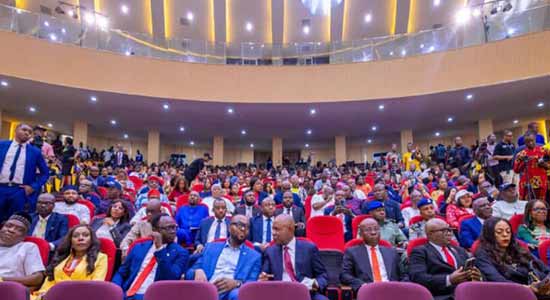
Enugu Targets 50,000 for 2026 Tech Festival to Drive Innovation

Published

on

Enugu Tech Festival 2026

Enugu Tech Festival 2026 aims for 50,000 participants, spotlighting innovation and transforming the state’s coal legacy into a thriving digital economy

The Enugu State Government has unveiled ambitious plans for the 2026 edition of the Enugu Tech Festival, targeting 50,000 participants from across the country.

Also read: Enugu to host 23rd national sports festival in 2026

Commissioner for Innovation, Science and Technology, Dr Lawrence Ezeh, made the announcement in Enugu while inaugurating the festival’s Central Planning Committee.

The event, themed ‘Coal to Code: Energy in New Form’, is scheduled to take place from 24 to 27 February 2026. It will explore how technology and innovation can transform Enugu’s coal heritage into a dynamic digital economy.

“We are building on the success of our inaugural Tech Festival, which attracted over 28,000 participants. For 2026, our target is 50,000,” Dr Ezeh said.

He explained that the festival supports the development vision of Governor Peter Mbah’s administration, which aims to make Enugu a leading hub for digital skills and innovation.

“This festival speaks directly to Governor Mbah’s commitment to a tech-enabled future for our state. We are creating an ecosystem that fosters creativity, innovation and job creation,” he added.

Dr Ezeh revealed that the planning committee includes a Local Organising Committee (LOC) and an advisory board. While the LOC will oversee logistics and stakeholder engagement, the advisory board will offer strategic direction and partnership mobilisation.

Activities lined up include keynote speeches, panel discussions, workshops, exhibitions, and networking events focused on entrepreneurship and digital growth.

He described the theme ‘Coal to Code’ as symbolic of Enugu’s evolution from a coal-powered past to a digitally-driven future.

“I was privileged to engage with global innovators at the VIVA Tech event in Paris. We want to replicate that energy and structure in Enugu, using international best practices blended with local ideas,” he said.

Also read: Enugu State nominates four historic sites for UNESCO world heritage status

Dr Ezeh encouraged the private sector, academic institutions, and youth to participate actively. He expressed confidence that the 2026 festival would attract local and international partnerships, boost innovation, and reposition Enugu as a tech investment destination.

Continue Reading
Click to comment

Leave a Reply

Culture

Crowds Gather for Rare Sunrise at Egypt’s Abu Simbel Temple

Published

on

Abu Simbel

Hundreds of tourists gathered at Egypt’s Abu Simbel temple to witness the twice-yearly sunrise ceremony illuminating Pharaoh Ramses II’s statue

Hundreds of tourists gathered at Egypt’s Abu Simbel temple on Thursday to witness a spectacular sunrise phenomenon in which sunlight illuminated the face of the statue of Pharaoh Ramses II, an event that occurs only twice a year.

Also read: 16 Famous Cultural Festivals That Define India

The ancient astronomical ceremony drew visitors from different parts of the world to the archaeological site in southern Egypt on October 22, one of two dates associated with the phenomenon.

The second occurrence takes place on February 22, when the rising sun illuminates the temple’s interior.

Egyptian tour guide Yasser Fouad described the occasion as extraordinary, saying some visitors had stayed overnight to secure the opportunity to witness the event.

“Today is an extraordinary day, everyone is keen, there are people who stayed over the night, foreigners who actually spent the night in Abu Simbel to see this phenomenon,” Fouad said.

The Great Temple of Ramses II at Abu Simbel dates back to the 13th century BC and is among Egypt’s most prominent archaeological attractions.

Built during the reign of Ramses II, one of ancient Egypt’s most powerful pharaohs, the temple is renowned for its monumental statues and sophisticated architectural design.

The twice-yearly sunrise phenomenon is a major attraction, drawing visitors eager to witness the interaction between sunlight and the temple’s ancient structure.

The dates have traditionally been associated with significant moments in Ramses II’s life.

October 22 is commonly linked to his birthday, while February 22 is associated with his accession to the throne.

However, the precise historical reasons behind the dates remain debated.

Some archaeologists have proposed alternative explanations, including that they may have marked the pharaoh’s coronation and birthday.

Abu Simbel underwent a major international rescue operation in the 1960s, when archaeologists and engineers relocated the temples to protect them from flooding caused by the construction of the Aswan High Dam.

The monumental structures were cut into large blocks and reassembled at a higher location, preserving the site for future generations.

The relocation was one of the most significant archaeological preservation projects of the 20th century.

Despite the move, the temple continues to attract visitors for its ancient Egyptian art, monumental architecture and remarkable alignment with the rising sun.

Also read: 16 Famous Cultural Festivals That Define India

The annual gatherings highlight the enduring appeal of Egypt’s archaeological heritage and the continuing fascination with the astronomical knowledge and engineering achievements of its ancient civilisation.

Continue Reading

Entertainment

Gbenga Adeyinka Brings Laffmattazz 2026 Finale to Lagos

Published

on

Laffmattazz

Laffmattazz 2026 Lagos finale will hold on November 15, as Gbenga Adeyinka brings comedy, music, culture and fashion to Victoria Island

(more…)

Continue Reading

Entertainment

The Headies Announces New Date for 18th Awards Edition

Published

on

Headies

The Headies has rescheduled its 18th awards edition to April 10 and 11, 2027, in Toronto, Canada, with industry events continuing

(more…)

Continue Reading

Trending