Opinion
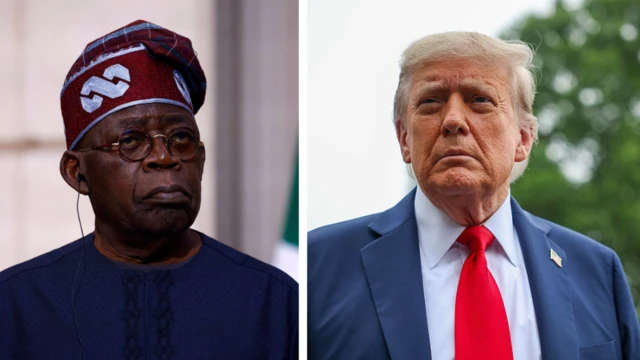
Before Tinubu metamorphoses into another Donald Trump…
Published
6 months agoon

Bola BOLAWOLE
President Bola Tinubu threatens Executive Orders against governors resisting Supreme Court judgment on local government financial autonomy
President Bola Ahmed Tinubu has threatened to resort to the use of “Executive Orders”, made so notorious by the United States President Donald Trump, to beat our governors into line if they continue to resist the implementation of the Supreme Court judgment granting financial autonomy to the country’s 774 local governments.
Also read: Atiku blackmails Tinubu over Dapo Abiodun, others refusal to pay LG allocations directly
Tinubu spoke at a function of his party, APC, whose official leader he is. As of 21 December, 2025, there are 28 APC governors, four PDP governors, and one each for Accord, APGA, Labour, and NNPP. What this means is that the majority of the governors disobeying the Supreme Court order belongs to the president’s party.
What strong reasons do they have? Twenty-eight APC governors cannot be so flippant or patently unruly as to stand against not just their own party leader, but one who is also the president and commander-in-chief of the country’s armed forces!
How many states, if I may ask, are implementing the Supreme Court judgment? And why is this so? The president, coming out openly to chide his party’s leaders in the states – which the governors are – is replete with meanings which, I dare to say, are ominous.
Tinubu spoken to the governors in camera before coming into the open to pillory them? Will this not have consequences for the president, the governors, and their party going forward? Already, the president’s action is reverberating and troubling the country’s political waters. The opposition cannot but take note!
It does appear as if all is not at ease within the ruling party, despite the facade of invincibility being built with the gale of defection into the party.
Those who say that defection brings its own internal contradictions may be right afterall. Strange bed-fellows and political opportunists simply running after personal interests come with bags and baggage. In the fullness of time, things may unravel.
Perhaps it has started already; maybe the storm is just gathering; as it would appear that the falcons can no longer hear – or are unwilling to heed – the falconer’s call.
Whoever advised Tinubu to spill the beans, the way he did, and at the forum he chose to address the matter, has done him incalculable damage.
Or is this another case of the president just “summoning the courage”, against the best of advice? Whichever is the case, it gives away the info that all may not be well within the APC.
A party machinery with clay feet is what the president’s speech has just exposed to the public. Is this a demonstration of (over) confidence? But “Let him who thinks he stands take heed lest he falls” (1 Corinthians 10:12)!
Besides, the venue of the president’s warning – at an APC function – is inappropriate. Was the message meant only for APC governors? Were they the only ones disobeying the Supreme Court order? Is it that the president cares less about the eight other governors belonging to the other parties? Is he only interested in saving the neck of his own party governors from the ‘apocalypse’ he threatens? Or will he be satisfied once his party’s governors comply with the Supreme Court order, even if governors from the other parties do not? The president’s statement would better have been made at a gathering of all the 36 state governors or at a meeting of none of them at all!
Now, if all – or majority – of the governors are united in disobeying the Supreme Court order, it immediately sends a signal that something very serious is amiss. Like I said earlier, the governors cannot all be unruly or flippant across many lines.
There are ministers of God among them. Their membership cuts across ethnic and religious divides – even if they are all members of the same decadent ruling class. So, what aileth them? Have they been called in to express their grouse? Maybe the governors are angry that it was the president who took this matter to court! Maybe the president, having exhausted all other options, was at his wits’ end before he did. Is this, then, a case of the flexing of muscles? When two elephants fight…
The opinion of many is that the state governors are opposed to local government autonomy because of corruption: That state governors corner local government resources, thereby denying the third-tier of government the resources to bring governance – and the dividends of democracy – closer to the people, the local governments being the touted government that is nearest to the grassroots. This may be true; it may also be false.
Corruption has become so endemic in Nigeria that it permeates every sector – private and public – every tier of government – federal, state and local government – and every arm of government – the executive, the legislature and the judiciary.
In fact, corruption struts like a colossus in our churches and mosques. The traditional institutions are not spared.
Even the little the Local Governments reportedly get from their state governments goes down the drain pipes of corruption.
So, if stemming corruption is the reason for local government autonomy, forget it! Corruption at the local government level is not lesser that what operates at the state or federal level.
Also, the question of local government autonomy engineered from the Centre and rammed down the throat of federating units is antithetical to the principles of federalism, which we purport to practice. Federalism properly so-called recognises only two tiers of government, the central authority and the federating units.
That was the case during the First Republic with the Central authority (the Federal Government) and the regional governments – Northern Region, Western Region, Eastern Region and, from 1963, the Mid-West Region. It is the responsibility of each region to create, own, fund, and organise the existence and operation of its own local governments without interference from the Central authority. We should return to that!
If we take the states as the federating units (in place of the regions), then, it is the states that should be vested with the powers to create local governments, fund them, equip them, organise them, run them and be answerable for their performance.
The problems of additional local government creation that came up between Lagos State’s Gov. Bola Ahmed Tinubu (as he then was) and the then President Olusegun Obasanjo would have been avoided.
States will create the number of local governments they deem necessary, without interference from the Federal Government.
If this is the view of the state governors, I dare to say that they are in order. But what they must then do is move to amend the law.
Should the state governors obey the Supreme Court judgment on local government autonomy even if they disagree with its import? Opinion is divided on this.
One side of the argument says yes, so that we do not resort to self-help or allow for anarchy; while efforts are on to amend the offensive sections of the Constitution, obey the law.
The Supreme Court being the highest court of the land, and Nigeria no longer a British colony where appeal can still proceed to the Privy Council in London, the judgment should be obeyed, pending any amendment to the law. The law is the law, as they say.
However, the other side says to obey is to continue with, and carry forward, an aberration that makes a mockery of our federalism.
Once obedience is secured, the urge to do the needful recedes. The process of amendment is usually tortuous and cumbersome.
Unfortunately, we are no longer in the age of activist judges who, while interpreting the law, also make laws.
Those were the days of the likes of Kayode Esho, Chukwudifu Oputa, Akinola Aguda, among others.
And this brings us to the issue of why judges – and their judgments – command scant regard from Nigerians these days, moreso from politicians.
The answer is simple: Like we had said earlier, corruption now permeates everywhere and the Bar and Bench are not spared.
No one knows this better than politicians! So, the respect, fear and awe that judges commanded in times past have waned.
These days, we hear mind-boggling tales of how judgments are procured and this cannot but whittle down their acceptance by those at the receiving end of some of these judgments.
And those wondering why court judgments are not respected should know that this is not a new phenomenon. Justice Dolapo Akinsanya’s judgment declaring the ING of Ernest Shonekan illegal, was it respected? The Supreme Court judgment that shot down President Olusegun Obasanjo’s seizure of Lagos State local government funds under Gov. Tinubu, was it respected?
Ask Chief Gani Fawehinmi and the other activists how many court judgments they got, but which were ignored by successive Nigerian governments! Has the Tinubu presidency itself not seized local government funds in Osun state? The judgment that PUNCH newspapers and my humble self got over the illegal closure of the newspaper and my detention, was it respected to this day by the Federal Government? I can go on and on! So, what goes around comes around!
Rather than pick and choose which court decisions to enforce, we should work towards treating all court judgments as sacrosanct.
The judges themselves must work to clean up their act and return us to that era when the Bench was seen as an unpolluted citadel of justice and the court as the last hope of the common man. Otherwise, forget it!
Also read: Atiku blackmails Tinubu over Dapo Abiodun, others refusal to pay LG allocations directly
Last Word: To my highly esteemed readers, Merry Christmas and compliments of this season!
Related
You may like

Tinubu, Obasanjo Praise Rotary’s Polio Eradication Efforts

Brymo Advocates Igbo Presidency, Calls for National Unity in Nigeria

Yinka Alaseyori Sparks Outrage With Tinubu Defence Remarks

If you’re enjoying Tinubu’s policies raise your hand

Oyo 2027: Party chieftains petition Tinubu over ‘desperate elements’ hijacking APC structure

Tinubu Praises Longtime Aide Tunde Rahman at 60
Opinion
Seven prime ministers in a decade: What Nigeria can learn from Britain’s chaos
Published
4 days agoon
July 2, 2026
By Dr Toju Ogbe,
The resignation of British Prime Minister Keir Starmer, less than two years after leading the Labour Party to a landslide electoral victory, was dramatic, yet reflected a pattern we have become familiar with in recent British politics.
Also read: Abolish state of origin: A prerequisite for true national integration
Starmer now joins a procession of fallen prime ministers stretching back to 2016 – from David Cameron to Theresa May, Boris Johnson, Liz Truss, and Rishi Sunak.
None of these prime ministers was ousted through military intervention, popular insurrection, or a court order. Rather, each was ultimately brought down by the same political system that elevated them to electoral glory.
To the casual observer, the rapid turnover of British Prime Ministers in the last decade may appear chaotic, or even a symptom of political instability. Some argue that the British electorate has become ungovernable.
However, beneath the apparent chaos at Westminster lies an uncomfortable truth that African democracies would do well to examine, particularly Nigerians who wonder why our democracy has delivered so little despite almost three decades of uninterrupted civilian rule.
The turbulence of British politics over the last decade, presents an important lesson on democratic accountability beyond successful elections.
Once the prime minister is deemed a liability by their own political party, the mechanics of accountability are activated. The daggers are quietly drawn and the ruthless pressure to resign begins.
Every poll and survey on public opinion is closely monitored, local election results are taken as a referendum on leadership. Cabinet resignations begin to gain momentum and backbenchers get restless.
Once the news media smells an internal uprising, they amplify scrutiny of the prime minister, subjecting every move – speech, public appearance, political misstep etc to relentless examination.
Pressure gradually mounts until the prospect of bitter internal leadership challenge becomes impossible to resist. The Prime Minister falls.
For every British Prime Minister, winning an election is merely the beginning of examination, not the end. Political survival lasts only for as long as the prime minister maintains the confidence of his party and the parliament.
This is the muscle of British democratic accountability; a political culture that prioritises institutional survival over individual ambition. Starmer recognised this reality in his resignation speech:
“The question my party is asking now is whether I am best placed to lead us into the next general election. I have heard the answer of my parliamentary party to that question, and I accept that answer with good grace.”
That closing sentence alone is a masterclass in British institutional democracy. The party spoke. The leader listened. The correction comes from within.
Nigeria presents a strikingly different political logic.
Nigeria on the other hand, presents an interesting contrast with a different political logic and culture.
The notion that a governing party would overtly interrogate the performance of its own leader and engineer a transition to someone better equipped to maintain public confidence, is in most cases politically unthinkable in Nigeria.
Political parties in Nigeria do not coalesce around ideological principles; rather, they operate more as electoral instruments organised around powerful individuals.
Internal dissent is often dealt with as betrayals rather than as part of healthy democratic engagement. Godfatherism and transactional loyalties shape political succession and leadership retention.
Once elected in Nigeria, there is an inherent assumption that a governor or president has a fixed two-term lease on power.
While 10 Downing Street is preparing to welcome its seventh Prime Minister in a decade, Nigeria, in contrast, has had only two democratically elected presidents during the same period – one of whom is still serving.
Social and economic conditions may deteriorate. Insecurity may worsen. Campaign promises may be ignored.
Public frustrations may become unbearable. Yet, incumbent governors and presidents often remain insulated from meaningful internal scrutiny and are even routinely anointed as ‘consensus’ candidate for second terms provided loyalties to godfathers, rather than the electorates are maintained.
The consequence is that loyalty, instead of performance is often rewarded at the expense of accountability.
This is not an argument for a revolving door at Aso Rock, as frequent leadership changes, by themselves, do not guarantee good governance.
Rather it is a case for making accountability an integral aspect of party politics in Nigeria.
Although the Nigerian presidential system provides for a fixed four-year term regardless of party confidence, political parties should however, be more than instruments for election campaigns, activated to simply retain or take over power every four years.
Electoral victory, should not be the ultimate goal, but the starting point of public service where democratic legitimacy must be continuously earned.
Equally important, political parties must develop the institutional maturity to honestly evaluate their own leaders. They must prioritise public interest and institutional credibility over loyalty to ‘Godfathers’.
The ultimate lesson from Westminster’s revolving door is clear: the true strength of a democratic system, lies not in the ability to produce leaders, but the capacity to effectively replace them, when they no longer command confidence.
Protecting failing leaders from accountability weakens democracy and political parties must ensure that no leader is more powerful than the institution.
Also read: Abolish state of origin: A prerequisite for true national integration
As political parties gear up for the 2027 general elections, the political class must decide what matters more: we can continue to reward blind loyalty and endure predictable decline, or discover the courage to demand accountability from those who seek to lead us.
Related
Opinion
Chief Obafemi Awolowo and the fabric of Nigeria’s history and society
Published
4 days agoon
July 2, 2026
By Sabella Ogbobode Abidde,
As a scholar, I have always wanted to edit or co-edit a book on the Big Ten of Nigerian nationalists, focusing on their lives, times, and generational impact from the nineteenth to the twenty-first century.
Also read: Abolish state of origin: A prerequisite for true national integration
An august list would include greats such as Aminu Kano, Herbert Macaulay, Nnamdi Azikiwe, Alvan Ikoku, Anthony Enahoro, Ahmadu Bello, Egbert Udo Udoma, Tafawa Balewa, Obafemi Awolowo, Eyo Ita, and Nnamdi Azikiwe. Two or more scholarly volumes would be ready before I bid farewell to my academic career.
But for now, this column briefly sheds light on a philosopher and mystic, who was also a political and economic giant: Chief Obafemi Awolowo.
His impact is multigenerational and wondrously woven into the fabric of Nigeria’s history, culture, and society.
Publicly available records indicate that the Nigerian nationalist movement began in the 1920s (Awolowo was born in 1909), so he had forebearers in the movement.
He later became one of the movement’s central figures, and by independence in October 1960, he had perhaps become the dominant personality shaping Nigeria’s political development and economic growth.
Awolowo was also a federalist. The first Premier of the Western region of Nigeria. The founder of the Yoruba nationalist group Egbe Omo Oduduwa.
He was the leader of the Action Group (AG), a political party and an opposition leader in the federal parliament, from 1959 to 1963.
A noted lawyer, author, journalist, and the founder and publisher of the Nigerian Tribune newspaper.
And in later years, under the first military regime, he served as the federal commissioner for finance and as vice chairman of the Federal Executive Council during the Nigerian-Biafran Civil War, 1967-1970.
Much later, Awolowo founded the Unity Party of Nigeria (UPN) and became the party’s presidential candidate in 1979 and 1983.
The consensus was that, on both occasions – especially in 1979 – the electoral body, acting at the behest of the then military regime, put its foot and thumb on the ballot-counting machines to the detriment of Awolowo.
In other words, those who voted didn’t count; the military counted and secured the votes for their preferred candidate.
Those officially sanctioned electoral irregularities, many Nigerians have asserted, partially account for why Nigeria has remained politically and economically miserable and socially chaotic in the years since.
And in the years since his passing, many of the so-called Awoists — men and women who claimed to be adherents and practitioners of his precepts — have fallen by the wayside.
They failed! By 1997, one rarely finds a school of politicians parading themselves as students of or members of the Awolowo Cathedral.
In the second decade of the twenty-first century, many politicians lack the impudence to call themselves Awoists.
The irony is that in the northern part of Nigeria, one can rarely find a pool of politicians who, today, adhere to the teachings and practices of Mallam Aminu Kano. And in the east, there are no more followers of Dr. Nnamdi Azikiwe.
Many politicians, from the east to the west, from the north to the south, and from the middle belt to the south-south, have done away with ethics, morality, ideology, or remaining faithful to their political parties.
Most no longer care about party manifestos or going to the State House, National Assembly, or the Presidency with the people’s burden on their hearts or shoulders.
In public or in private, participants in the Nigerian political and economic space think nothing about integrity, posterity, nation-building, or national interest. It is mostly about self-interest now.
That is what Nigeria has become! Many of the good, effective, efficient, visionary, and purposeful Nigerians are in hiding, while the audaciously corrupt are masters of the game, leaders at various levels of governance.
And we expect to change for the better? Heck no! It is a painful three-ring circus at all three levels.
I do not for once contend that the Federal Republic of Nigeria is a lost cause, a lost experiment, a lost entity, or a forsaken project. No! It can be saved; it can be brought back from the edge of the cliff.
And I also do not for once think that Nigeria should be partitioned into three or four separate countries.
Oh, no! I believe that sustained, first-rate, courageous, and visionary leadership can turn the Nigerian ship around. It is doable. This is not a hopeless country. It is not!
Many of the institutions Awolowo built are still going strong. Many of his policies have been proven right and correct. Many of his teachings have been found to be the appropriate panaceas for Nigeria.
And many of the physical infrastructure projects he built lasted for more than four decades.
And so, imagine where Nigeria would be today on the development scale – on the same level as Taiwan, South Korea, New Zealand, China, and Australia? Or the oil-rich Middle East countries.
Not having Chief Obafemi Awolowo as the president of this federation set her back three to four decades.
Examined dispassionately, his economic and political achievements have yet to be rivaled for several decades after his premiership of the western region, and neither has his commissionership (now minister) of the finance portfolio.
He was good, he was great, and he was miles above his contemporaries in the development of their various regions and in their generational legacies.
Without Awolowo’s policies, much of southern Nigeria – especially the western region — would perhaps be one of the least developed in today’s Nigeria.
Directly and indirectly, Awolowo was the man who made it possible for millions of Nigerians and their offspring to dream of and have a better life.
He promised, he delivered; he built and encouraged others, such as Michael Adekunle Ajasin (Ondo State), Lateef Kayode Jakande (Lagos State), Bola Ige (Oyo State), and Olabisi Onabanjo (Ogun State), to be builders.
If General Yakubu Dan-Yumma Gowon was the most consequential military leader Nigeria has ever had, Chief Obafemi Jeremiah Oyeniyi Awolowo, was the single most consequential leader and public figure beginning with his premiership in 1954.
Above all else, he was a family man, a good man, a good Nigerian, and a Pan-Africanist. He was better than most and far better than we thought. That’s Awo for you, a man who’s woven into our consciousness.
Also read: Abolish state of origin: A prerequisite for true national integration
Chief Obafemi Awolowo would have been 117 this year, but he died at 78 in 1987 at his home in Ikenne, Ogun State. Chief Hannah Idowu Dideolu Awolowo, affectionally called HID, was Awolowo’s “jewel of inestimable value.” He had said of her: “I do not hesitate to confess that I owe my success in life to three factors: the Grace of God, a Spartan self-discipline, and a good wife. Our home is to all of us, a true haven; a place of happiness, and of imperturbable seclusion from the buffetings of life.” HID was born in Ikenne, in1915 and passed in 2015 in the same locality. She was 99. It was a union and a marriage that lasted for five glorious decades.
Related
Opinion
Abolish state of origin: A prerequisite for true national integration
Published
5 days agoon
July 1, 2026
By Nosa Ota Osaikhuiwu,
Nigeria stands at a critical point in its national development. Nearly sixty-six years after independence, our nation continues to struggle with divisions rooted in ethnicity, tribalism, and the outdated concept of “state of origin.”
Also read: Celebrating Tunji Bello at 65…
If Nigeria is to become a truly united and prosperous nation, we must fundamentally rethink how citizenship is defined and practiced.
One of the greatest obstacles to national unity is the continued emphasis on state of origin rather than state of residence. Every Nigerian is first and foremost a citizen of Nigeria.
Yet our laws, government policies, and administrative procedures continue to classify citizens according to ancestral origin instead of where they actually live, work, pay taxes, and contribute to society.
It is time for the National Assembly to enact legislation abolishing the use of state of origin and replacing it with state or local government of residence for all official government purposes.
Equal Citizenship Through Residency
The proposed legislation should clearly define residency requirements.
Once a Nigerian has legally resided in a state or local government for a specified number of years and has fulfilled obligations such as tax payment and other civic responsibilities, that individual should enjoy the same rights, privileges, opportunities, and responsibilities as any indigene of that community.
No Nigerian should remain a perpetual “stranger” in any part of the country where they have chosen to build their lives.
Such rights should include:
- Equal access to public employment.
- Eligibility for admissions into educational institutions.
- The right to vote and be voted for where they reside.
- Equal access to government services and social benefits.
- The right to own property without discrimination.
- Full participation in local political and economic life.
Ending Institutionalized Tribalism
The present system unintentionally encourages tribal loyalty over national citizenship. Rather than identifying primarily as Nigerians, many citizens first identify with their ancestral states because government policies reward those classifications.
As a result, national discussions frequently become contests over which state or ethnic group benefits most from federal appointments, infrastructure projects, or public resources instead of focusing on what best serves Nigeria as a whole.
Replacing state of origin with state of residence would gradually change this mindset by encouraging Nigerians to invest emotionally, economically, and politically in the communities where they actually live.
Better Planning and Fairer Resource Allocation
This reform would also improve national planning. Today, millions of Nigerians live permanently outside their ancestral states.
Yet many official records continue to associate them with their states of origin rather than their places of residence. For example, a state may officially have twenty million people by origin, while only ten million actually reside there.
Meanwhile, another state may receive ten million migrants who require roads, hospitals, schools, housing, water, electricity, and other public services, but existing policies will not adequately recognize snd compensate for this situation.
Government planning should reflect where people actually live, not where their ancestors came from.
Using residence as the basis for census data, budgeting, infrastructure development, healthcare planning, educational investments, and revenue allocation would produce more accurate statistics and more efficient public spending.
Promoting National Unity
Many prominent Nigerians were born outside their ancestral states. Nevertheless, our current administrative system compels them to identify only with their ancestral origins. Nigeria should move beyond this outdated arrangement.
Citizenship should be based upon commitment to one’s community of residence rather than ancestry.
This reform would promote:
- National integration.
- Social cohesion.
- Equal opportunity.
- Economic mobility.
- Meritocracy.
- Reduced ethnic tension.
- Stronger democratic participation.
It would also encourage Nigerians to see every part of the country as home rather than limiting their identity to ancestral boundaries.
A Call to the National Assembly
As members of the National Assembly return to legislative business, we urge them to make this constitutional and legislative reform a national priority.
The use of state of origin in official documentation, public employment, educational admissions, and government programmes should be gradually phased out and replaced with state or local government of residence.
Nigeria belongs to all Nigerians.
Our laws should reflect that simple but powerful truth by promoting equal citizenship, national unity, and shared responsibility rather than perpetuating divisions based on ancestral origin.
If we truly desire one united Nigeria, then every Nigerian must have the freedom to live, work, participate, and prosper in any part of the country without discrimination.
Replacing state of origin with state of residence would be one of the boldest and most transformative reforms in Nigeria’s democratic history.
It would move our nation closer to the promise of equal citizenship envisioned in our Constitution and help build a stronger, more united Federal Republic where every Nigerian is at home anywhere in Nigeria.
Also read: Celebrating Tunji Bello at 65…
Finally, I urge all Nigerians irrespective of their places of origin to join this call and reach to their representatives, senators, governors and indeed the president through phone calls, letters and online to support this initiative for true national integration and cohesion.
Related

Spyro Reveals Emotional Story Behind Meeting Future Wife

Tinubu Directs FCCPC Investigation Into Big Tech Market Conduct

Nigeria Consulate in South Africa Condemns Fresh Wave of Xenophobic Violence Against Businesses, Churches
Trending
Business3 years agoOoni of Ife Discusses Business and Peace Initiative in Kenya
Culture3 years agoThe Four Igbo Market Days and Their Significance In Omenala ÌGBÒ
Events3 years agoGlamour, glitz as B’obagunwa Omo’ba Obinrin Akile Ijebu celebrates New Year party (Photos)
Culture3 years agoOutrage as Ezendigbo of Ibadanland confers chieftaincy title on Olubadan
Events3 years agoOnitoomu of Ito-Omu installs two new chiefs (Video, Photos)
Events2 years agoEgbe Bobasete: The New Fashion Sensation Elevates 2024 Ojude Oba Festival (Video, Photos)
Paranormal3 years agoBlack Cat Superstition: Good and Bad Luck Beliefs
Events3 years agoLaminisa I, HRM Oba Dr. Lawal, marks 15years on throne