Wole Soyinka Door of Return speech celebrates Badagry’s symbolic festival, calling it a historic beginning of unity and heritage for Africans in diaspora
Wole Soyinka Door of Return celebration in Badagry has been described by Nobel Laureate, Prof Wole Soyinka, as a historic beginning of a stupendous cultural and spiritual event reconnecting Africa with its diaspora.
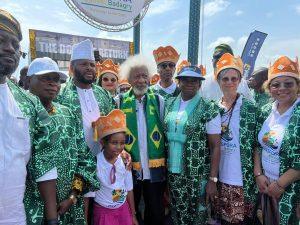
Soyinka, who served as the special guest of honour at the fifth Badagry Door of Return Festival in Lagos, praised the organisers for reviving the continent’s historical and emotional ties with descendants of enslaved Africans.
He commended Hon. Abike Dabiri-Erewa, Chairman/CEO of the Nigerians in Diaspora Commission (NIDCOM), alongside the three chairmen of Badagry local governments and Lagos lawmaker Hon. Solomon Bonu, for their collaborative efforts in sustaining the festival’s vision.
According to Soyinka, the fifth edition marks the beginning of the much-anticipated Heritage Voyage of Return, a symbolic journey that will commence in Brazil next year and end in Badagry, Lagos.
“No voyage is complete without the other,” Soyinka said. “What we are celebrating is a formal beginning of a stupendous event that would bring not just the thousands we see here but millions.
The diasporas are willing to come back, eager and obsessed with the notion of return. I pray that the sadness that once enveloped the Point of No Return will turn to joy.”
Earlier, Hon. Abike Dabiri-Erewa welcomed 57 participants from Brazil, America, the United Kingdom, Cuba, Haiti, and Benin Republic, who were received as “Kings and Queens” through the Door of Return—a powerful reversal of history from the dark era when their ancestors were taken away as slaves through the Point of No Return.
She described the festival as a “historic, emotional, spiritual and economic reconnection to the motherland,” and expressed gratitude to Professor Soyinka, whom she called “a legend and inspiration to all.”
Dabiri-Erewa also applauded Governor Babajide Sanwo-Olu for establishing a permanent Door of Return site in Badagry, calling it a legacy that would anchor Lagos as a leading centre for cultural tourism.
Representing the Lagos State Governor, the Special Adviser on Tourism, Arts and Culture, Mr Idris Aregbe, reiterated the state’s commitment to making Lagos a welcoming home for the global African family.
He assured participants that the permanent site would be completed ahead of the next festival.
In her remarks, Cuban Ambassador to Nigeria, Amb. Miriam Morales Palmero, reflected on the deep historical connections between Cuba and Africa.
Quoting historian Fernando Ortiz, she said, “Cuba without the blacks will not be Cuba,” emphasising the profound contributions of Africans to the Cuban identity.
Hon. Solomon Bonu, Chairman of the Lagos House Committee on Tourism, described the event as a “heritage bridge between Africa and her children abroad,” pledging legislative support for tourism and heritage preservation.
Hon. Babatunde Hunpe, Chairman of Badagry Local Government, speaking on behalf of his colleagues, thanked Dabiri-Erewa for putting Badagry on the global map and expressed appreciation to Professor Soyinka for his enduring love for the people and the diaspora.
Among the participants were international personalities such as Jeffrey Daniels of the hit band Shalamar, Dr David Anderson, author of Gracism, and the Consul-General of Brazil to Nigeria, Celso França.
They each described the festival as a deeply emotional and joyous return to their ancestral roots.
The Wole Soyinka Door of Return celebration continues to grow as a symbol of unity, remembrance, and cultural pride—redefining Africa’s narrative from loss to reconnection, and from pain to purpose.










 Culture4 years ago


