Connect with us

Culture

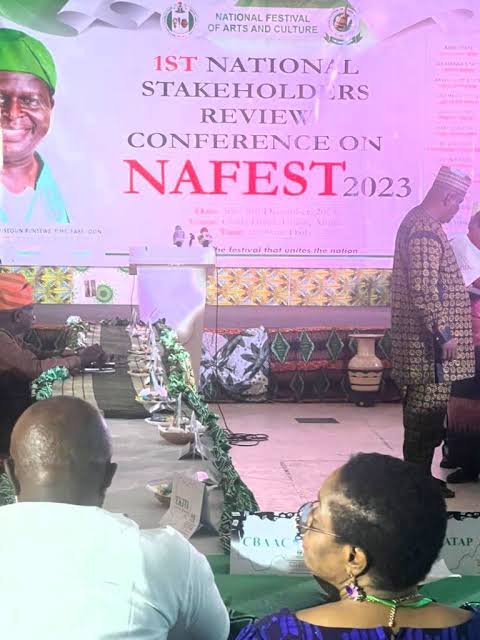
NAFEST 2023 Deliberates Naira Boost Through Culture Repositioning

Published

on

The Nigerian government must reposition the country’s rich cultural resources if it wishes to massively grow the Gross Domestic Product (GDP).

The Director General National Council for Arts and Culture, Mr. Olusegun Runsewe stated this at the first day of the maiden edition of the National Festival of Arts and Culture (NAFEST)’s stakeholders conference holding in Abuja, Nigeria’s capital.

The Director General while presenting a paper titled ” Culture As a Tool for Revamping the Economy : An Agenda Setting “ emphasised the importance of reassessing the cultural sector and implementing new strategies to align it with the federal government’s agenda.

Runsewe says: The culture sector has immense potential to boost the economy if properly harnessed.
The Nigerian government should prioritise skill acquisition training as part of efforts to equip the population with the necessary skills and capacities to become productive members of society. States in Nigeria must work towards developing cultural markets within their respective regions”. He said.

To accelerate cultural activities and enhance visibility, relevance and viability of the culture sector in Nigeria,
Runsewe calls on all stakeholders in the arts and culture sector to begin to apply more creative energies to optimising the huge potentials that abound.

“It is my hope that if our cultural resources are carefully harnessed and productively channelled, it will open up our cultural economy and engender rapid socio-economic growth.
“It would also lead to the emergence of a strong and stable currency that will command the required purchasing power at the international market,” He said.

To further support the development of the sector, Runsewe mentioned plans to leverage the intervention of the Bank of Industry (BOI). He noted that NCAC had entered into an agreement with the Chinese Ambassador to Nigeria to provide technical skills training to 3,700 youths in various fields.

The fields include hospitality, arts and crafts, elevator machine production and installation, mono-rail construction, branding, electric car repairs and more.

The day one of NAFEST 2023 witnessed inauguration of a committee to review NAFEST’s past 35 editions. Those that made the list were, Mr Dotun Osunsanya, a culture consultant, Mr Victor Omoniyi, Director with NCAC; Mr Ado Yahuza, Executive Secretary, National Institute for Cultural Orientation (NICO) and some delegates from Yobe and Rivers states, to look into the review in the course of the four-day conference.

More so, delegates from 28 states of the federation and other stakeholders were segmented into 8 syndicate group to discuss extensively on how to further develop the culture and tourism sector. One of the 8 groups named the Skills Acquisition of NAFEST comprises delegates from, Katsina, Kano, Cross River, Lagos and Osun states.

Another group named E-Marketing, consists of delegates from Lagos, Edo, Ebonyi and Jigawa states as well as National President of the National Association of Nigeria Travel Agencies and National Association Nigeria Theatre Practitioners. Some other delegates were also selected to review aspects like: cultural exchange, synergy between tourism and culture, e-marketing and one state one product.

The Director General said a document will be produced from the groups discussions and sent to the Nigerian government to aid in revamping the sector.

Culture

Dexter Loko Wins Prestigious 2026 Chinua Achebe Prize

Published

on

 Dexter Loko Wins Chinua Achebe Prize for his 170,000-word fantasy novel, The Bako of Zereshé, at the 2026 ANA convention in Abuja

(more…)

Continue Reading

Culture

Ofala festival: Obi of Onitsha marks 25 Years on throne

Published

on

 Ofala Festival 2026 celebrated Onitsha’s royal heritage as Obi Nnaemeka Achebe marked 25 years on the throne and addressed Nigeria’s economic challenges.

(more…)

Continue Reading

Culture

Crowds Gather for Rare Sunrise at Egypt’s Abu Simbel Temple

Published

on

Abu Simbel

Hundreds of tourists gathered at Egypt’s Abu Simbel temple to witness the twice-yearly sunrise ceremony illuminating Pharaoh Ramses II’s statue

Hundreds of tourists gathered at Egypt’s Abu Simbel temple on Thursday to witness a spectacular sunrise phenomenon in which sunlight illuminated the face of the statue of Pharaoh Ramses II, an event that occurs only twice a year.

Also read: 16 Famous Cultural Festivals That Define India

The ancient astronomical ceremony drew visitors from different parts of the world to the archaeological site in southern Egypt on October 22, one of two dates associated with the phenomenon.

The second occurrence takes place on February 22, when the rising sun illuminates the temple’s interior.

Egyptian tour guide Yasser Fouad described the occasion as extraordinary, saying some visitors had stayed overnight to secure the opportunity to witness the event.

“Today is an extraordinary day, everyone is keen, there are people who stayed over the night, foreigners who actually spent the night in Abu Simbel to see this phenomenon,” Fouad said.

The Great Temple of Ramses II at Abu Simbel dates back to the 13th century BC and is among Egypt’s most prominent archaeological attractions.

Built during the reign of Ramses II, one of ancient Egypt’s most powerful pharaohs, the temple is renowned for its monumental statues and sophisticated architectural design.

The twice-yearly sunrise phenomenon is a major attraction, drawing visitors eager to witness the interaction between sunlight and the temple’s ancient structure.

The dates have traditionally been associated with significant moments in Ramses II’s life.

October 22 is commonly linked to his birthday, while February 22 is associated with his accession to the throne.

However, the precise historical reasons behind the dates remain debated.

Some archaeologists have proposed alternative explanations, including that they may have marked the pharaoh’s coronation and birthday.

Abu Simbel underwent a major international rescue operation in the 1960s, when archaeologists and engineers relocated the temples to protect them from flooding caused by the construction of the Aswan High Dam.

The monumental structures were cut into large blocks and reassembled at a higher location, preserving the site for future generations.

The relocation was one of the most significant archaeological preservation projects of the 20th century.

Despite the move, the temple continues to attract visitors for its ancient Egyptian art, monumental architecture and remarkable alignment with the rising sun.

Also read: 16 Famous Cultural Festivals That Define India

The annual gatherings highlight the enduring appeal of Egypt’s archaeological heritage and the continuing fascination with the astronomical knowledge and engineering achievements of its ancient civilisation.

Continue Reading

Trending