Connect with us

Culture

Ibrahim Chatta leads Balogun Adesoye dynasty at Ojude Oba 2025 in dazzling cultural display

Published

on

Ibrahim Chatta leads Balogun

Nollywood star Ibrahim Chatta joins Balogun Adesoye dynasty for an iconic display at Ojude Oba 2025, thrilling dignitaries with deep Yoruba cultural pride

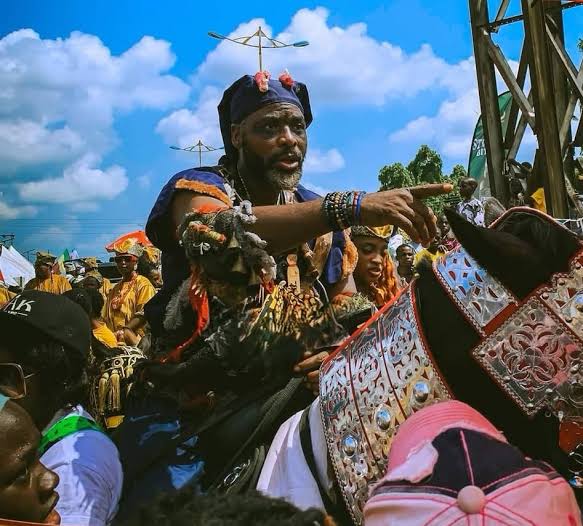
Ibrahim Chatta leads Balogun Adesoye dynasty in a spellbinding procession at the 2025 Ojude Oba Festival, marking one of the most talked-about highlights of this year’s edition of the iconic Yoruba cultural celebration.

Also read: Ojude Oba Festival boosts tourism, youth enterprise, cultural identity in Ogun

The Nollywood star actor joined Osi Balogun Adegboyega Adesoye to champion the family’s majestic entry at the event, which took place on Sunday, June 8 in Ijebu Ode.

Chatta, who is renowned for his deep cultural sensibilities, described the experience as one of the proudest moments of his life.

He reflected on the momentous participation, saying, “Being part of the Ojude Oba festival through the Balogun Adesoye’s dynasty  right here with the Ijebu people  was beyond anything I imagined. The love I received, the warmth, the cheers. I felt it deeply.”

The actor further noted, “Ojude Oba is more than a festival  it’s a celebration of unity, heritage, and pride. For over a century, it has stood as a symbol of the Ijebu people’s cultural strength, and I’m incredibly honoured to be part of that legacy.”

This year’s celebration, attended by Governor Dapo Abiodun, Olori Adetona, Minister for Culture, Arts, Tourism and Creative Economy Barrister Hannatu Musawa and other dignitaries, featured over 80 fashionably dressed regberegbe social groups and around 20 horse-riding families.

Among the latter, the Balogun Adesoye dynasty stood out with a commanding entry into the pavilion, led by Osi Balogun Adegboyega Adesoye and joined by Chatta, who electrified the crowd with his regal charisma and stirring Yoruba chant.

Donning bright yellow attires, the Adesoye contingent rode in with 70 horses, drawing standing ovations and admiration from the stands and VIP galleries alike.

The Nollywood actor’s ability to connect with both the cultural spirit and the attending audience left many in awe, as the Balogun Adesoye family’s presentation emerged as one of the most memorable performances of the festival.

Before arriving at the pavilion, the dynasty paraded through the streets of Ijebu Ode, drawing cheers from onlookers. The day’s events climaxed in a dazzling expression of cultural elegance that reasserted Ojude Oba’s status as a prestigious event of Yoruba tradition.

In his remarks, Osi Balogun Adegboyega Daud Adesoye said the family’s display was the product of detailed planning and unity. “As children, grandchildren, and great-grandchildren of the late Balogun Fasasi Adesoye Onasanya, we’re all united in happiness.

This year’s Ojude Oba brought our family even closer together… From here, it only gets better,” he said, speaking from the historic Balogun Fasasi Adesoye mansion in Oke-Ijasi, Ijebu Ode.

Also read: Ojude Oba Festival: Unpacking the deeper meanings of Nigeria’s cultural jewel

Ojude Oba 2025 once again confirmed its standing not just as a cultural showpiece but also as a vibrant reaffirmation of identity, royalty and tradition — where legends, both ancient and new, are celebrated with pride.

Culture

Dexter Loko Wins Prestigious 2026 Chinua Achebe Prize

Published

on

 Dexter Loko Wins Chinua Achebe Prize for his 170,000-word fantasy novel, The Bako of Zereshé, at the 2026 ANA convention in Abuja

(more…)

Continue Reading

Culture

Ofala festival: Obi of Onitsha marks 25 Years on throne

Published

on

 Ofala Festival 2026 celebrated Onitsha’s royal heritage as Obi Nnaemeka Achebe marked 25 years on the throne and addressed Nigeria’s economic challenges.

(more…)

Continue Reading

Culture

Crowds Gather for Rare Sunrise at Egypt’s Abu Simbel Temple

Published

on

Abu Simbel

Hundreds of tourists gathered at Egypt’s Abu Simbel temple to witness the twice-yearly sunrise ceremony illuminating Pharaoh Ramses II’s statue

Hundreds of tourists gathered at Egypt’s Abu Simbel temple on Thursday to witness a spectacular sunrise phenomenon in which sunlight illuminated the face of the statue of Pharaoh Ramses II, an event that occurs only twice a year.

Also read: 16 Famous Cultural Festivals That Define India

The ancient astronomical ceremony drew visitors from different parts of the world to the archaeological site in southern Egypt on October 22, one of two dates associated with the phenomenon.

The second occurrence takes place on February 22, when the rising sun illuminates the temple’s interior.

Egyptian tour guide Yasser Fouad described the occasion as extraordinary, saying some visitors had stayed overnight to secure the opportunity to witness the event.

“Today is an extraordinary day, everyone is keen, there are people who stayed over the night, foreigners who actually spent the night in Abu Simbel to see this phenomenon,” Fouad said.

The Great Temple of Ramses II at Abu Simbel dates back to the 13th century BC and is among Egypt’s most prominent archaeological attractions.

Built during the reign of Ramses II, one of ancient Egypt’s most powerful pharaohs, the temple is renowned for its monumental statues and sophisticated architectural design.

The twice-yearly sunrise phenomenon is a major attraction, drawing visitors eager to witness the interaction between sunlight and the temple’s ancient structure.

The dates have traditionally been associated with significant moments in Ramses II’s life.

October 22 is commonly linked to his birthday, while February 22 is associated with his accession to the throne.

However, the precise historical reasons behind the dates remain debated.

Some archaeologists have proposed alternative explanations, including that they may have marked the pharaoh’s coronation and birthday.

Abu Simbel underwent a major international rescue operation in the 1960s, when archaeologists and engineers relocated the temples to protect them from flooding caused by the construction of the Aswan High Dam.

The monumental structures were cut into large blocks and reassembled at a higher location, preserving the site for future generations.

The relocation was one of the most significant archaeological preservation projects of the 20th century.

Despite the move, the temple continues to attract visitors for its ancient Egyptian art, monumental architecture and remarkable alignment with the rising sun.

Also read: 16 Famous Cultural Festivals That Define India

The annual gatherings highlight the enduring appeal of Egypt’s archaeological heritage and the continuing fascination with the astronomical knowledge and engineering achievements of its ancient civilisation.

Continue Reading

Trending