Western Balkans creative economy gains momentum as an €8m EU-funded project supports artists, cultural organisations and regional partnerships
An €8 million European Union-funded cultural initiative, implemented by UNESCO, the British Council and the Italian Agency for Development Cooperation (AICS), has supported more than 300 creative initiatives, nearly 500 events and 106 mobility activities across the Western Balkans since its launch in April 2022, strengthening opportunities for artists and cultural organisations while deepening the region’s connections with Europe.
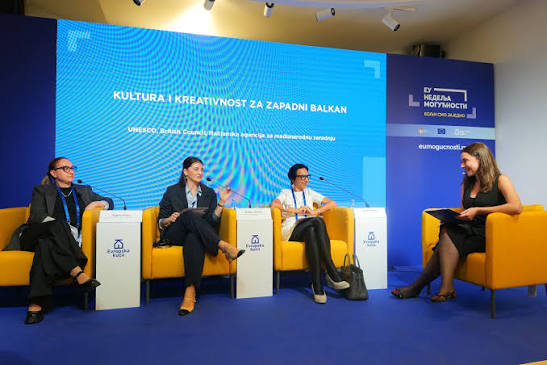
The achievements of the Culture and Creativity for the Western Balkans (CC4WBs) project were highlighted at its closing celebration and networking event held on 18 November 2026 in Brussels, Belgium, where representatives of European institutions, implementing organisations and project beneficiaries gathered to assess its impact and discuss the future of cultural cooperation.
Although the Brussels event marked an important milestone, the initiative is scheduled to reach its official conclusion in March 2027.
The project has recorded significant participation across the region, reaching more than one million citizens and audience members, with 26,000 direct beneficiaries.
Among those directly reached were 4,822 young people, 3,039 artists, 1,436 representatives of cultural and creative industries, and 1,320 students.
The figures demonstrate the growing importance of the Western Balkans creative economy as a platform for employment, professional development, international partnerships and cultural exchange.
The initiative covered several creative disciplines, including performing and visual arts, audiovisual production, interactive media, cultural heritage, cultural tourism, design and creative services.
Particular attention was given to strengthening professional skills, improving organisational capacity, supporting artists’ mobility and expanding access to funding and international markets.
At the Brussels gathering, participants examined how cultural investment could contribute to European integration, sustainable economic development, regional cooperation and stronger social connections among communities.
Georg Häusler, Director for Culture, Creativity and Sport at the European Commission’s Directorate-General for Education, Youth, Sport and Culture, praised the project’s achievements and its contribution to cross-border partnerships.
“Through the Culture and Creativity for the Western Balkans’ project, the EU has strengthened the region’s cultural and creative sectors and helped build lasting partnerships across borders; partnerships that bring communities closer together and support good neighbourly relations,” Häusler said.
He congratulated more than 200 grantees alongside UNESCO, the British Council and AICS for their contributions to the initiative.
Häusler also indicated that the European Union intended to maintain its cultural engagement with countries involved in its enlargement and neighbourhood partnerships after the project’s completion.
He announced plans for a dedicated €5 million funding call under the Creative Europe programme in 2027, alongside a proposed High-Level Dialogue on Culture with enlargement partners.
The proposed funding represents an important indication that European cultural cooperation is expected to continue beyond the current programme.
Nayef Al-Fayez, UNESCO Assistant Director-General for Culture, also highlighted the relationship between cultural development, peacebuilding and sustainable communities.
“Culture plants a seed of peace in people’s minds. It drives social cohesion, inclusion, democratic development and sustainable economic growth,” Al-Fayez said.
He described CC4WBs as an example of what international cooperation could achieve when institutions and communities worked towards a shared cultural vision.
Al-Fayez urged stakeholders to sustain the opportunities created by the initiative, particularly through continued investment in cultural organisations and creative professionals across the region.
The British Council also highlighted the importance of investing in people as a foundation for long-term economic growth.
Eilidh Hamilton, British Council Director for the Western Balkans, said the programme had focused on equipping creative professionals and cultural organisations with the knowledge, skills and confidence required to adapt and develop sustainable operations.
She maintained that the region’s greatest creative asset remained the talent, ambition and innovation of its people.
Grazia Sgarra, Director of the AICS Rome Office for Civil Society Organisations, Partnership and Finance for Development, similarly emphasised that cultural investment should be viewed as more than an effort to preserve historical traditions.
According to Sgarra, culture provides opportunities for economic participation, social inclusion and dialogue between communities.
She stressed that developing people’s skills and creative capacities remained essential to achieving sustainable development.
Beyond the formal discussions, the Brussels gathering provided an opportunity for beneficiaries and institutional representatives to reconnect, exchange experiences and explore new partnerships.
The event also celebrated the region’s contemporary creative talent, concluding with a performance by Helem Nejse, a Sarajevo-based musical collective whose appearance brought a cultural dimension to the networking programme.
The group’s performance offered a reminder of the creative diversity that the initiative has sought to support across the Western Balkans.
As CC4WBs approaches its scheduled conclusion in March 2027, attention is increasingly turning towards preserving the partnerships, professional networks and institutional capacities developed over the past four years.
The project’s achievements also highlight the potential of cultural industries to contribute to regional economic development, particularly by creating opportunities for young people, independent artists and small creative organisations.
For the European Union and its implementing partners, the next challenge will be ensuring that the relationships and opportunities established through the programme continue beyond its funding period.
The initiative’s broader legacy is therefore expected to extend beyond the number of events organised or grants awarded, reflecting the role of culture in building stronger communities, encouraging international cooperation and connecting the Western Balkans more closely with Europe.








 Culture4 years ago


