Connect with us

Culture

Sultan of Sokoto Arrives in Ibadan for Olubadan Coronation

Published

on

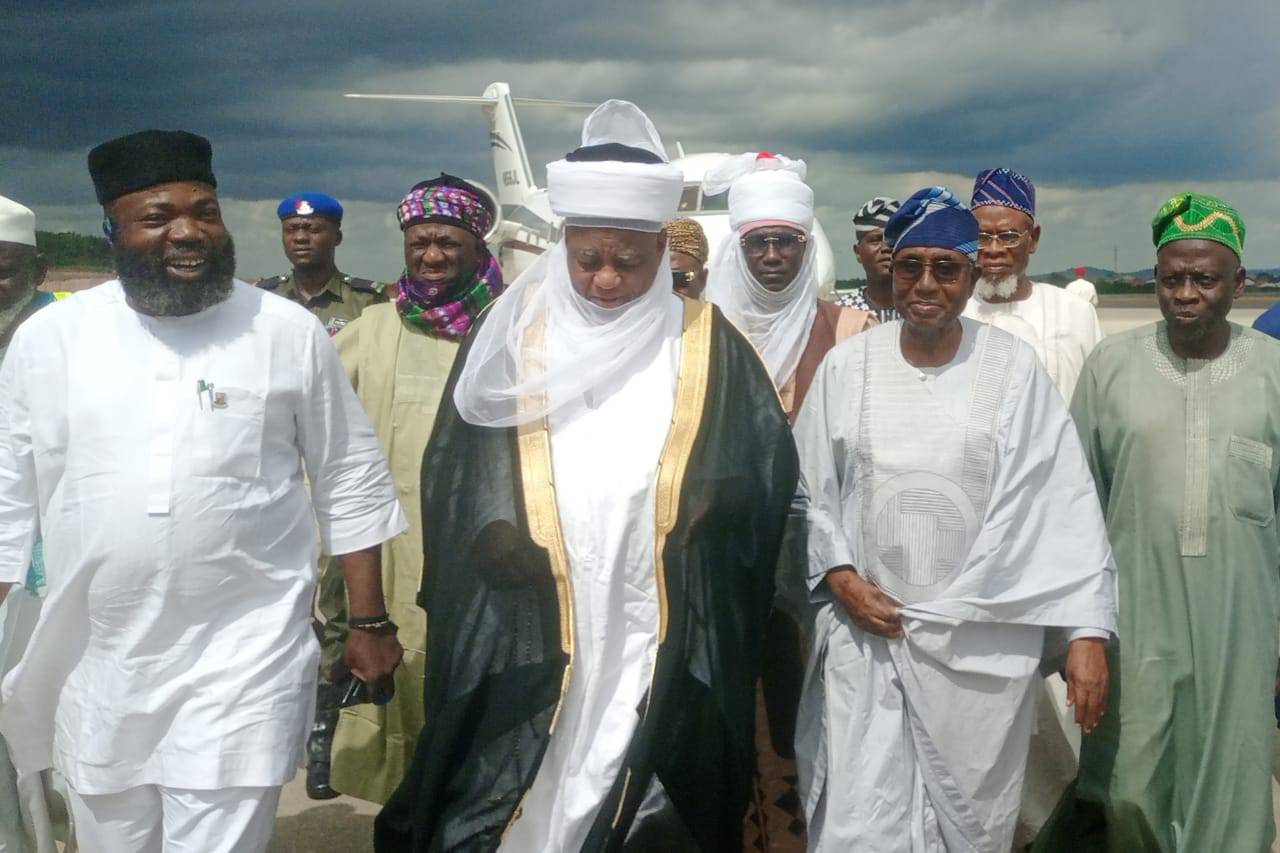
Sultan of Sokoto arrives in Ibadan

Sultan of Sokoto arrives in Ibadan for the coronation of Oba Rashidi Ladoja as the 44th Olubadan, adding prestige to the historic ceremony

Sultan of Sokoto arrives in Ibadan ahead of the coronation of Oba Rashidi Adewolu Ladoja as the 44th Olubadan of Ibadanland, lending national significance to the historic event.

Also read: Ooni of Ife Pays Courtesy Visit to Olubadan-Designate Rashidi Ladoja

His arrival was confirmed in a statement released on Thursday by his palace media team, noting that the plane carrying the Sultan touched down at 2:50 pm.

He was accompanied by senior counsellor of the Sultanate Council, Sokoto, and District Head of Kilgori, His Royal Highness Dr Mohammed Jabi Kilgori.

The Sultan, who is also co-chairman of the National Council of Traditional Rulers of Nigeria and President-General of the Nigeria Supreme Council for Islamic Affairs (NSCIA), was warmly received at the airport by Oyo State Commissioner for Works, Alhaji Mojeed Mogbonjubola, Deputy President-General NSCIA (South), Alhaji Rasaki Oladejo, and MUSWEN Executive Secretary, Professor Muslih Yahaya.

The coronation of Oba Ladoja is scheduled to climax a week-long programme of cultural and religious activities at the historic Mapo Hall ground.

Chief Bayo Oyero, chairman of the Coronation Planning and Organising Committee, said the events were designed to showcase Ibadan’s inclusive and vibrant heritage.

According to Oyero, the programme began on Monday, September 22, with inter-religious prayers, a cultural fiesta, a coronation lecture and a thanksgiving service.

He described Oba Ladoja’s ascension as “a journey of many years, guided by the wisdom of our ancestors,” stressing that his experience as a senator, governor, businessman and administrator positions him to lead Ibadan into “a new era of progress, peace and prosperity.”

The Sultan’s presence underscores both cultural unity and religious symbolism.

Also read: Oyo Restricts Traffic for Olubadan Rashidi Ladoja’s Coronation Ceremony

As leader of Nigeria’s Muslim community, his participation lends spiritual blessing and national prestige to what promises to be one of the most memorable coronations in Ibadan’s history.

Culture

Dexter Loko Wins Prestigious 2026 Chinua Achebe Prize

Published

on

 Dexter Loko Wins Chinua Achebe Prize for his 170,000-word fantasy novel, The Bako of Zereshé, at the 2026 ANA convention in Abuja

(more…)

Continue Reading

Culture

Ofala festival: Obi of Onitsha marks 25 Years on throne

Published

on

 Ofala Festival 2026 celebrated Onitsha’s royal heritage as Obi Nnaemeka Achebe marked 25 years on the throne and addressed Nigeria’s economic challenges.

(more…)

Continue Reading

Culture

Crowds Gather for Rare Sunrise at Egypt’s Abu Simbel Temple

Published

on

Abu Simbel

Hundreds of tourists gathered at Egypt’s Abu Simbel temple to witness the twice-yearly sunrise ceremony illuminating Pharaoh Ramses II’s statue

Hundreds of tourists gathered at Egypt’s Abu Simbel temple on Thursday to witness a spectacular sunrise phenomenon in which sunlight illuminated the face of the statue of Pharaoh Ramses II, an event that occurs only twice a year.

Also read: 16 Famous Cultural Festivals That Define India

The ancient astronomical ceremony drew visitors from different parts of the world to the archaeological site in southern Egypt on October 22, one of two dates associated with the phenomenon.

The second occurrence takes place on February 22, when the rising sun illuminates the temple’s interior.

Egyptian tour guide Yasser Fouad described the occasion as extraordinary, saying some visitors had stayed overnight to secure the opportunity to witness the event.

“Today is an extraordinary day, everyone is keen, there are people who stayed over the night, foreigners who actually spent the night in Abu Simbel to see this phenomenon,” Fouad said.

The Great Temple of Ramses II at Abu Simbel dates back to the 13th century BC and is among Egypt’s most prominent archaeological attractions.

Built during the reign of Ramses II, one of ancient Egypt’s most powerful pharaohs, the temple is renowned for its monumental statues and sophisticated architectural design.

The twice-yearly sunrise phenomenon is a major attraction, drawing visitors eager to witness the interaction between sunlight and the temple’s ancient structure.

The dates have traditionally been associated with significant moments in Ramses II’s life.

October 22 is commonly linked to his birthday, while February 22 is associated with his accession to the throne.

However, the precise historical reasons behind the dates remain debated.

Some archaeologists have proposed alternative explanations, including that they may have marked the pharaoh’s coronation and birthday.

Abu Simbel underwent a major international rescue operation in the 1960s, when archaeologists and engineers relocated the temples to protect them from flooding caused by the construction of the Aswan High Dam.

The monumental structures were cut into large blocks and reassembled at a higher location, preserving the site for future generations.

The relocation was one of the most significant archaeological preservation projects of the 20th century.

Despite the move, the temple continues to attract visitors for its ancient Egyptian art, monumental architecture and remarkable alignment with the rising sun.

Also read: 16 Famous Cultural Festivals That Define India

The annual gatherings highlight the enduring appeal of Egypt’s archaeological heritage and the continuing fascination with the astronomical knowledge and engineering achievements of its ancient civilisation.

Continue Reading

Trending