Culture
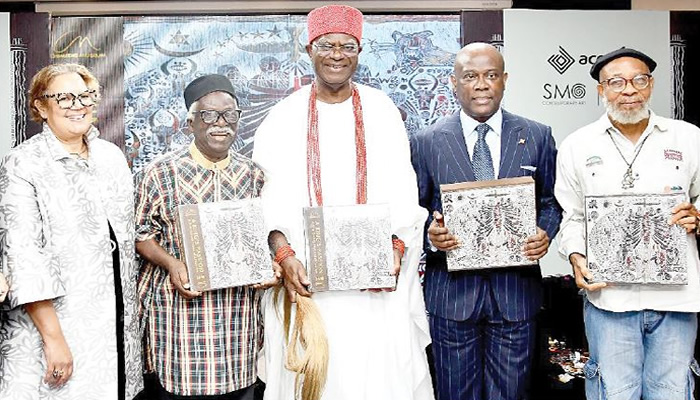
In A King’s Passion… Obi of Onitsha interrogates African art, culture
Published
3 years agoon
By
Lanre
According to the monarch, passion, intellectual curiosity and intuition of over 40 years inspired the collection of more than 4000 artworks, of which over 300 are featured in the book.
The publication addresses the emerging role of art patronship in Africa and how indigenous collectors are expanding narratives on the art of the African continent.
Lavishly illustrated in full colour, A King’s Passion was edited by Sandra Mbanefo Obiago (SMO) Contemporary Art and features 120 artists and carefully selected modern and contemporary masterpieces, including works by Ben Enwonwu, Uche Okeke, Amon Kotei, El Anatsui, Ablade Glover, Twins Seven Seven, Ndidi Dike, Godfried Donkor, Midy, Mxolisi Dolla Sapeta, Kofi Agorsor, Frew Kebede Gemech, Tizta Berhanu and many more.
It also includes, critical essays by some of the finest scholars and experts on African art such as, Sylvester Ogbechie, Frank Ugiomoh, Edwin Bodjawah, Babacar Mbow, KrdyzIkwuemesi, Jerry Buhari, Bernard Akoi-Jackson, Chike Nwagbogu and Oliver Enwonwu, and others.
He said, “the book fulfils its primary objective to foster research into modern and contemporary art in Africa by challenging the existing canon and helping to raise funds for the Chimedie Museum.”
CEO of Access Holdings, one of the sponsors and host of the event, Herbert Wigwe, said, “the impact of Igwe Achebe’s exquisite art collection and his strategic art patronage for over 40 years nurturing African talent, is a beautiful example of how creativity can create wealth from the grassroots all the way up through society, and create important paradigm shifts about our identity, our culture, and our history.”
He added, “the book strategically shows how art can contribute to developing our continent and telling a fresh story with ancient roots.”
Co-sponsor of the event, Ford Foundation, represented by its current Director for West Africa, Dr. Chichi Anyiagolu-Okoye, said, “the Obi of Onitsha did not establish the museum for the love of art only, but also because of his understanding of the importance of owning one’s own story, narrative and passing it down in a cultural context that is true to its original meaning.”
According to Anyiagolu-Okoye, “the Chimedie Museum will help teach, inspire and connect communities, especially at this time, when discourse on the return of African artefacts from Europe to its rightful owners is taking centre stage.”
The launch included a critical book review by art curator and architect, Jess Castelotte, and a vibrant panel discussion by leading experts in the African art market including, Senior Director of Sotheby’s auction house; Hannah O’Leary, award winning photographer, Kelechi Amadi-Obi, leading African art collector and philanthropist, Femi Akinsanya and Founder of the ART X Lagos art fair Tokini Peterside-Schwebig, who all related how their love for art preservation began. The discussion was moderated by Convener of Design Week Lagos, Titi Ogufere.
The book editor, Founder and Artistic Director of SMO Contemporary Art, Sandra Mbanefo Obiago, said, “the Chimedie Museum will be an important repository of art collection as well as photographs, music and video recordings, royal regalia including costumes, jewelry, hats, ornaments, and historic documents and research materials, including the digital copies of the entire academic socio-anthropological study of Onitsha.”
Related
You may like

Ofala festival: Obi of Onitsha marks 25 Years on throne

Darlington Raymond’s Art Sparks Memories at Bradford Festival

Exeter Bids for 2029 City of Culture to Celebrate Heritage, Innovation, and Sport

Ogun State to Host Annual Drums Festival, Boosting Culture and Tourism

Benin Art Fair 2025 Showcases Legacy and Innovation

Promising Ogun Cultural Economy Vision Unveiled by Abiodun
Culture
Ofala festival: Obi of Onitsha marks 25 Years on throne
Published
4 hours agoon
October 23, 2026
Ofala Festival 2026 celebrated Onitsha’s royal heritage as Obi Nnaemeka Achebe marked 25 years on the throne and addressed Nigeria’s economic challenges.
Related
Culture
Crowds Gather for Rare Sunrise at Egypt’s Abu Simbel Temple
Published
5 hours agoon
October 23, 2026
Hundreds of tourists gathered at Egypt’s Abu Simbel temple to witness the twice-yearly sunrise ceremony illuminating Pharaoh Ramses II’s statue
Hundreds of tourists gathered at Egypt’s Abu Simbel temple on Thursday to witness a spectacular sunrise phenomenon in which sunlight illuminated the face of the statue of Pharaoh Ramses II, an event that occurs only twice a year.
Also read: 16 Famous Cultural Festivals That Define India
The ancient astronomical ceremony drew visitors from different parts of the world to the archaeological site in southern Egypt on October 22, one of two dates associated with the phenomenon.
The second occurrence takes place on February 22, when the rising sun illuminates the temple’s interior.
Egyptian tour guide Yasser Fouad described the occasion as extraordinary, saying some visitors had stayed overnight to secure the opportunity to witness the event.
“Today is an extraordinary day, everyone is keen, there are people who stayed over the night, foreigners who actually spent the night in Abu Simbel to see this phenomenon,” Fouad said.
The Great Temple of Ramses II at Abu Simbel dates back to the 13th century BC and is among Egypt’s most prominent archaeological attractions.
Built during the reign of Ramses II, one of ancient Egypt’s most powerful pharaohs, the temple is renowned for its monumental statues and sophisticated architectural design.
The twice-yearly sunrise phenomenon is a major attraction, drawing visitors eager to witness the interaction between sunlight and the temple’s ancient structure.
The dates have traditionally been associated with significant moments in Ramses II’s life.
October 22 is commonly linked to his birthday, while February 22 is associated with his accession to the throne.
However, the precise historical reasons behind the dates remain debated.
Some archaeologists have proposed alternative explanations, including that they may have marked the pharaoh’s coronation and birthday.
Abu Simbel underwent a major international rescue operation in the 1960s, when archaeologists and engineers relocated the temples to protect them from flooding caused by the construction of the Aswan High Dam.
The monumental structures were cut into large blocks and reassembled at a higher location, preserving the site for future generations.
The relocation was one of the most significant archaeological preservation projects of the 20th century.
Despite the move, the temple continues to attract visitors for its ancient Egyptian art, monumental architecture and remarkable alignment with the rising sun.
Also read: 16 Famous Cultural Festivals That Define India
The annual gatherings highlight the enduring appeal of Egypt’s archaeological heritage and the continuing fascination with the astronomical knowledge and engineering achievements of its ancient civilisation.
Related

Ofala festival: Obi of Onitsha marks 25 Years on throne

Crowds Gather for Rare Sunrise at Egypt’s Abu Simbel Temple

16 Famous Cultural Festivals That Define India
Trending
Culture4 years agoThe Four Igbo Market Days and Their Significance In Omenala ÌGBÒ
Business4 years agoOoni of Ife Discusses Business and Peace Initiative in Kenya
Events4 years agoGlamour, glitz as B’obagunwa Omo’ba Obinrin Akile Ijebu celebrates New Year party (Photos)
Culture4 years agoOutrage as Ezendigbo of Ibadanland confers chieftaincy title on Olubadan
Events4 years agoOnitoomu of Ito-Omu installs two new chiefs (Video, Photos)
Events2 years agoEgbe Bobasete: The New Fashion Sensation Elevates 2024 Ojude Oba Festival (Video, Photos)
Events3 years agoNANTAP Convention 2023: Reshaping Nigerian Theatre Arts for economic growth
Paranormal4 years agoBlack Cat Superstition: Good and Bad Luck Beliefs